 Back
BackReasoning-centric AI models vs “Predictive” AI: Why Enterprises are Shifting in 2026
#PredictiveAI #AIModels #FutureOfAI #AITrends2026

Jay Anthony
5 January 2026 | 5 min read
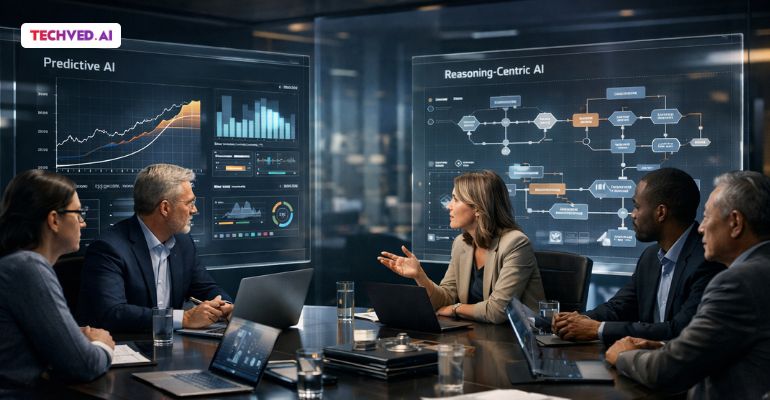
Every enterprise leader has felt it at some point:
“Our AI dashboards look impressive, but why do we still need humans to interpret everything and decide what to do next?”
For years, organizations invested heavily in predictive AI solutions; systems that forecast outcomes, flag risks, or recommend next steps. Yet, as business environments became more complex and fast-moving, prediction alone stopped being enough. Enterprises now need AI that can understand context, reason through scenarios, and act intelligently, not just predict.
This is why, in 2026, enterprises are increasingly shifting toward reasoning-centric AI models. Read on to know what that shift means, why it matters, and how companies can prepare for it, while showing how TECHVED, a leading digital transformation and tech innovation company, helps businesses adopt future-ready AI-powered solutions.
Predictive AI: Powerful, but Limited
Predictive AI has been the foundation of modern artificial intelligence in business. It analyses historical data to answer questions like:
- Will a customer churn?
- Is this transaction fraudulent?
- What will demand look like next quarter?
These systems power many AI chatbots, recommendation engines, and analytics tools. They have delivered value across industries, from finance and retail to healthcare and logistics.
However, predictive AI works best in stable environments where past data closely resembles the future. In today’s world, that’s marked by sudden market shifts, regulatory changes, and evolving customer behavior, the assumption often breaks down.
Predictive AI can tell you what might happen.
It usually cannot explain why, adapt in real time, or decide what to do next across multiple steps.
The Enterprise Reality Check
By 2025, many organizations reached a plateau with traditional generative AI and predictive systems. Common challenges included:
- AI outputs that required heavy human oversight
- Inability to connect insights across departments
- Static models that struggled with new or ambiguous situations
- AI automation services that worked only within narrow rules
Enterprises began asking a more advanced question:
Can AI think through problems the way our teams do, i.e., logically, contextually, and step-by-step?
That question led to the rise of reasoning-centric AI models.
What is Reasoning-Centric AI?
Reasoning-centric AI goes beyond prediction. Instead of only identifying patterns, it can:
- Break down complex problems into steps
- Evaluate multiple options before acting
- Understand cause-and-effect relationships
- Adjust decisions as new information arrives
In simple terms, predictive AI says:
“Based on past data, this is likely to happen.”
Reasoning-centric AI says:
“Here’s what’s happening now, why it matters, and what actions make sense next.”
This evolution is reshaping how business AI solutions are designed and deployed.
Why Enterprises Are Shifting in 2026
1. Businesses Need Decisions, Not Just Insights
Dashboards and forecasts are no longer enough. Leaders want AI-powered solutions that recommend actions, simulate outcomes, and learn continuously. Reasoning-centric AI supports real decision-making, not just reporting.
2. Workflows Are Becoming Autonomous
Modern enterprises aim to reduce manual intervention. Reasoning-based systems enable AI automation services that can manage entire workflows from monitoring and deciding to acting, and that, too, without constant human input.
3. Customers Expect Smarter Interactions
An advanced AI chatbot in 2026 must do more than answer FAQs. It should understand intent, remember context, and resolve issues end-to-end. Reasoning-centric AI enables more natural, human-like interactions.
4. Data Is Messy and Unpredictable
Real-world data is incomplete, conflicting, and dynamic. Reasoning models handle uncertainty better than traditional predictive approaches, making them more reliable in complex enterprise settings.
Predictive AI vs Reasoning-Centric AI: A Simple Comparison
Predictive AI Can:
- Forecasts outcomes
- Relies heavily on historical data
- Works well in stable conditions
- Requires human decision-making
Meanwhile, Reasoning-Centric AI Can:
- Evaluates situations
- Uses context + logic
- Adapts to change
- Supports autonomous decisions
This difference is driving enterprises to rethink what the best AI for their business actually looks like.
Impact Across Enterprise Functions
Operations
Reasoning AI can optimize supply chains by adjusting routes, vendors, and inventory levels dynamically and not just predicting delays.
Customer Experience
AI-powered agents resolve issues, escalate intelligently, and personalize responses using real-time reasoning.
Finance and Risk
Beyond forecasting risk, AI can explain exposure, simulate scenarios, and suggest mitigation strategies.
IT and Engineering
Teams increasingly rely on custom AI solutions that reason through system dependencies and automate incident resolution.
What This Means for AI Strategy
Enterprises can no longer rely on off-the-shelf tools alone. The shift toward reasoning-centric AI requires:
- Thoughtful AI consulting services
- Strong data and architecture foundations
- Domain-specific logic built into models
- Responsible and transparent AI design
This is where experienced AI development services and artificial intelligence services partners become critical.
How Reasoning Can AI Empower Enterprises
As a leading digital transformation and tech innovation company, TECHVED helps enterprises move beyond basic AI adoption to intelligent, reasoning-driven systems.
Through its comprehensive AI consulting services, TECHVED AI works closely with organisations to identify where predictive AI solutions fall short and where reasoning-centric models can deliver measurable impact.
Its offerings include:
- Custom AI solutions tailored to business goals
- Enterprise-grade AI-powered solutions for automation and decision intelligence
- Scalable business AI solutions integrated into existing ecosystems
- Responsible AI frameworks that ensure trust and compliance
By combining deep domain expertise with advanced artificial intelligence services, TECHVED enables enterprises to build AI systems that don’t just predict, but think, adapt, and act.
Looking Ahead: The Future of Enterprise AI
In 2026 and beyond, the competitive advantage will not come from having more data or more dashboards. It will come from having AI that understands your business well enough to reason through complexity and support real outcomes.
Predictive AI laid the foundation. Reasoning-centric AI is building the future.
Enterprises that embrace this shift, supported by the right AI companies and innovation partners, will be better equipped to navigate uncertainty, scale intelligently, and deliver meaningful value through AI-powered solutions.
The question is no longer whether to adopt reasoning-centric AI; but how fast you can make the transition.
Wish to read more and explore AI-backed possibilities? Click here!
FAQs
What is the main purpose of predictive AI?
The main purpose of predictive AI is to analyse historical and real-time data to forecast future outcomes and trends. It helps businesses make proactive, data-driven decisions and reduce uncertainty.
What is an example of predictive analysis?
An example of predictive analysis is using past sales and customer behaviour data to forecast future demand. Businesses also use it to predict customer churn and take preventive actions
What is the future of predictive analytics?
The future of predictive analytics lies in AI-driven, real-time models that continuously learn and adapt to changing data. It will increasingly power autonomous decisions, proactive risk management, and personalised business experiences.
What are the four steps in predictive analytics?
The four steps in predictive analytics are data collection, data preparation, model building, and prediction with evaluation. Together, they enable accurate forecasting and informed decision-making.
What is predictive approach in business analysis?
A predictive approach in business analysis uses historical and current data to forecast future trends, risks, and outcomes. It enables organisations to make proactive decisions rather than reacting to past performance.
Most Popular
How AI-Driven Video Content Is Revolutionising Business Communication
Synthetic Media Ethics: Maintaining Authenticity in the Age of Avatars
Why AI Is No Longer Optional for the Insurance Industry in 2026
Green AI for Enterprises: Building Energy-Efficient Intelligence at Scale
From Clicks to Conversations: How Video Messaging Is Replacing Traditional Funnels

Introducing HOLA VDA: The Future of Humanized AI Conversations
Digital Literacy 2.0: Navigating the Shift from Text to Video-First Communication
Written By
Jay Anthony
Marketing Head | TECHVED Consulting India Pvt. Ltd.
He led efforts to develop a fully integrated marketing communications plan and growing team. He is responsible for successful corporate re-brand and update of all branded assets.

Stay up-to-date with
all new market trends and
happenings
 #AIVideoContent #AIInBusiness #BusinessCommunication
How AI-Driven Video Content Is Revolutionising Business Communication
#SyntheticMedia #AIEthics #DigitalHumans #AIAvatars
Synthetic Media Ethics: Maintaining Authenticity in the Age of Avatars
#AgenticAI #InsuranceTech #AITrends2026 #InsuranceInnovation
Why AI Is No Longer Optional for the Insurance Industry in 2026
Ready To Transform?
Automate smarter. Create faster. Grow with AI.