 Back
BackWhy Enterprises Are Moving Beyond Conversational AI to AI Agents
#BeyondConversationalAI #RiseOfAIAgents #EnterpriseAIAgents #AgenticAI #FutureOfEnterpriseAI #AIAgentsInBusiness #EnterpriseAITransformation

Jay Anthony
23 July 2026 | 7 min read
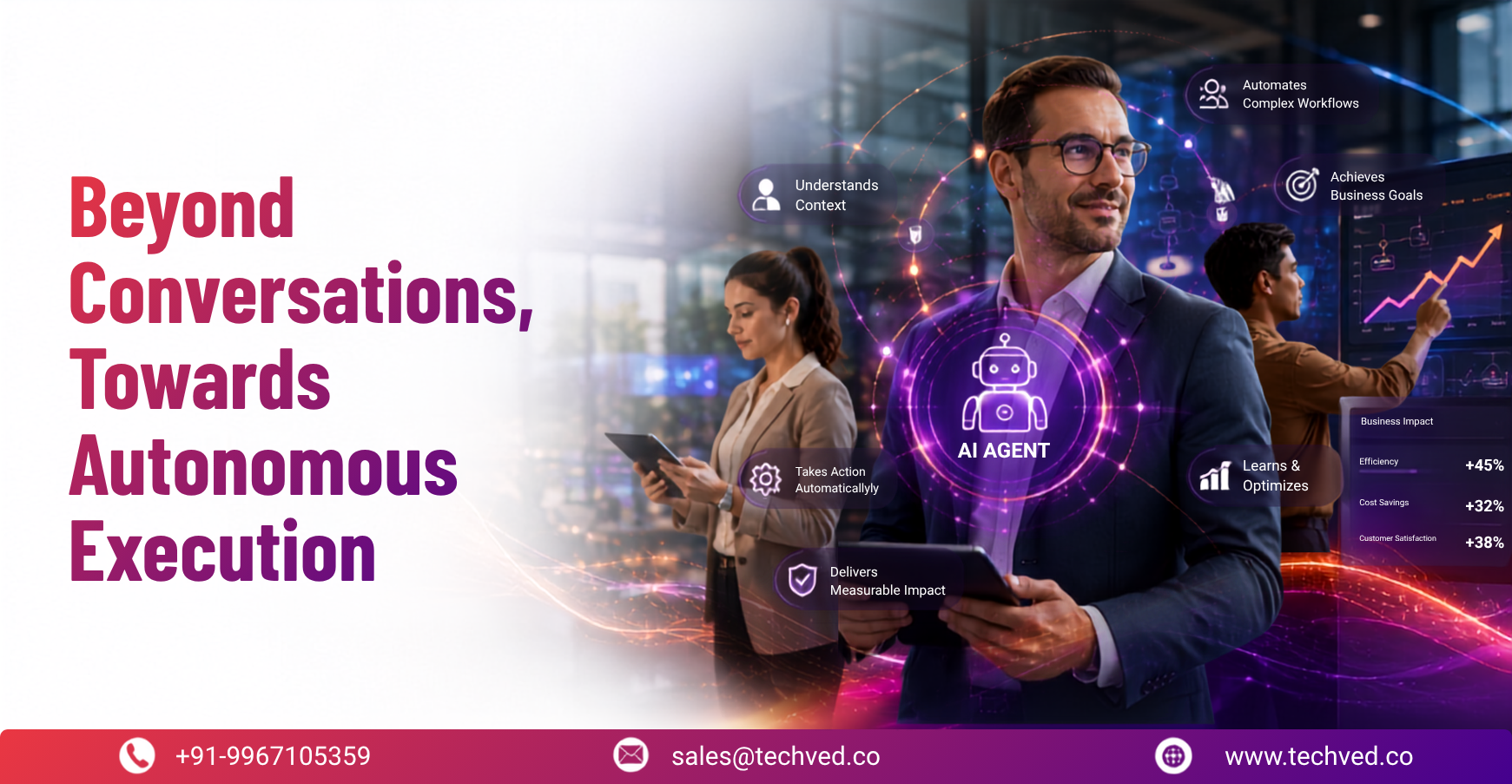
Customer Support Automation with Agentic AI
A leading insurance provider handles thousands of customer requests every day, including policy updates, claim status checks and premium payments.
With Agentic AI, the AI agent goes beyond answering questions. It verifies customer details, retrieves policy information, updates CRM records, initiates claim requests, schedules follow-ups and sends notifications—all within a single interaction. When human intervention is needed, the complete case history is shared, eliminating the need for customers to repeat information.
By automating end-to-end workflows, Agentic AI reduces response times, improves operational efficiency and delivers a faster, more seamless customer experience while enabling employees to focus on higher-value tasks.
Why Enterprises Are Moving Beyond Conversational AI
Artificial Intelligence has transformed the way businesses interact with customers, employees and partners. Over the past decade, Conversational AI has become a cornerstone of digital transformation, enabling enterprises to automate customer support, answer frequently asked questions and provide 24/7 assistance. While these capabilities have significantly improved operational efficiency, business expectations have evolved.
Today's enterprises are no longer looking for AI that simply responds to queries. They need AI that can understand context, make informed decisions, execute tasks and collaborate across systems with minimal human intervention. This shift has given rise to AI Agents, marking the next phase of enterprise AI adoption.
In this blog, we explore why organizations are moving beyond traditional conversational AI and how AI agents are redefining business operations.
The Evolution of Conversational AI
Conversational AI has come a long way from rule-based chatbots. Powered by Natural Language Processing (NLP) and Large Language Models (LLMs), modern virtual assistants can understand intent, generate human-like responses and deliver personalized experiences.
Businesses across industries have successfully adopted conversational AI for :
Customer support
Appointment scheduling
Product recommendations
Lead qualification
Employee help desks
Frequently asked questions
While these applications continue to create value, conversational AI is primarily designed to respond rather than act.
As enterprise workflows become increasingly complex, organizations require AI systems capable of handling tasks beyond conversations.
Why Conversational AI Alone Is No Longer Enough
Most enterprise processes involve multiple applications, approvals, business rules and data sources. Answering a question is only one part of the workflow.
Consider a customer requesting an insurance policy update. A conversational AI assistant may explain the process, but an AI agent can verify policy details, initiate the request, collect required documents, notify relevant teams and update the CRM automatically.
This transition from information delivery to task execution is driving enterprises towards more intelligent AI systems.
Key limitations of traditional conversational AI include :
Limited workflow execution
Minimal contextual memory
Dependency on predefined integrations
Difficulty handling multi-step processes
Limited decision-making capabilities
As enterprises pursue greater efficiency, these limitations become increasingly apparent.
Enter AI Agents : The Next Generation of Enterprise AI
AI Agents are intelligent systems capable of understanding goals, reasoning through tasks and taking action across enterprise applications.
Unlike conversational AI, AI agents do not simply answer questions—they execute workflows.
An AI agent can :
Retrieve information from multiple systems
Analyse business context
Recommend actions
Complete repetitive tasks
Trigger workflows
Collaborate with other AI agents
Learn from previous interactions
Rather than functioning as digital assistants, AI agents operate as digital teammates that augment human productivity.
Enterprise Use Cases Driving AI Agent Adoption
Organizations across industries are adopting AI agents to streamline operations and improve customer experiences.
Banking & Financial Services
AI agents assist with customer onboarding, fraud detection, loan processing, compliance checks and personalized financial recommendations while reducing manual effort.
Insurance
From policy servicing and claims assistance to underwriting support, AI agents accelerate processes that traditionally required multiple manual touchpoints.
Retail & E-commerce
Retailers leverage AI agents to manage inventory, recommend products, automate order tracking and enhance post-purchase engagement.
Healthcare
Healthcare organizations use AI agents to simplify appointment scheduling, patient communication, medical documentation and administrative workflows.
Enterprise IT
Internal AI agents support employees by resolving IT requests, managing knowledge repositories and automating repetitive service desk operations.
Why Businesses Are Investing in AI Agents
The adoption of AI agents is driven by measurable business outcomes rather than technology trends.
Organizations implementing AI agents are experiencing:
Faster response and resolution times
Increased employee productivity
Reduced operational costs
Improved customer satisfaction
Better process consistency
Enhanced scalability
Faster decision-making
Instead of replacing employees, AI agents enable teams to focus on higher-value work while repetitive tasks are automated.
Building an Enterprise AI Strategy
Implementing AI agents requires more than deploying a new technology platform. Enterprises need a strategic approach that aligns AI initiatives with business objectives.
Successful AI adoption begins with identifying high-impact use cases, integrating AI with existing enterprise systems and ensuring strong governance, security and compliance.
Organizations should also prioritise:
Clear business outcomes
Reliable enterprise data
Human oversight
Continuous performance monitoring
Scalable AI architecture
A well-planned AI strategy ensures that AI agents become valuable business assets rather than isolated automation tools.
The Future of Enterprise AI
The future of AI lies beyond conversations. Enterprises are increasingly adopting intelligent AI systems capable of reasoning, collaborating and executing business processes autonomously.
As AI technologies continue to mature, organizations will move from isolated AI assistants to interconnected AI ecosystems where multiple agents work together to deliver faster decisions, improved efficiency and seamless customer experiences.
Businesses that embrace this evolution today will be better positioned to drive innovation, improve operational agility and remain competitive in an AI-driven economy.
Conclusion :
Conversational AI laid the foundation for intelligent digital interactions, but enterprise needs have evolved. Today's organizations require AI that not only communicates effectively but also understands business context, automates workflows and delivers measurable outcomes.
AI agents represent this next evolution, enabling enterprises to move from simple conversations to intelligent action. By combining advanced reasoning, automation and seamless integration with enterprise systems, businesses can unlock greater efficiency, accelerate decision-making and create exceptional customer experiences.
At TECHVED.AI, we help enterprises design, implement and scale AI-powered solutions that go beyond traditional automation. From intelligent virtual assistants to enterprise AI agents, our solutions empower organizations to transform business operations and drive long-term growth.
Most Popular
How AI-Driven Video Content Is Revolutionising Business Communication
Synthetic Media Ethics: Maintaining Authenticity in the Age of Avatars
Why AI Is No Longer Optional for the Insurance Industry in 2026
Green AI for Enterprises: Building Energy-Efficient Intelligence at Scale
From Clicks to Conversations: How Video Messaging Is Replacing Traditional Funnels
Introducing HOLA VDA: The Future of Humanized AI Conversations
Digital Literacy 2.0: Navigating the Shift from Text to Video-First Communication
Written By
Jay Anthony
Marketing Manager | TECHVED Consulting India Pvt. Ltd
Jay Anthony holds expertise across a broad range of tech and innovation sectors. Driven by a passion for exploring ideas and sharing insight, Jay aims to craft work that is thoughtful, engaging and accessible. Whether diving into new subjects or reflecting on familiar ones, the goal is always to connect with readers and offer something meaningful.

Stay up-to-date with
all new market trends and
happenings
 #AIVideoContent #AIInBusiness #BusinessCommunication
How AI-Driven Video Content Is Revolutionising Business Communication
#SyntheticMedia #AIEthics #DigitalHumans #AIAvatars
Synthetic Media Ethics: Maintaining Authenticity in the Age of Avatars
#AgenticAI #InsuranceTech #AITrends2026 #InsuranceInnovation
Why AI Is No Longer Optional for the Insurance Industry in 2026
Ready To Transform?
Automate smarter. Create faster. Grow with AI.