 Back
BackDigital Literacy 2.0: Navigating the Shift from Text to Video-First Communication
#VideoAI #DigitalLiteracy #FutureOfWork

Jay Anthony
12 March 2026 | 6 min read
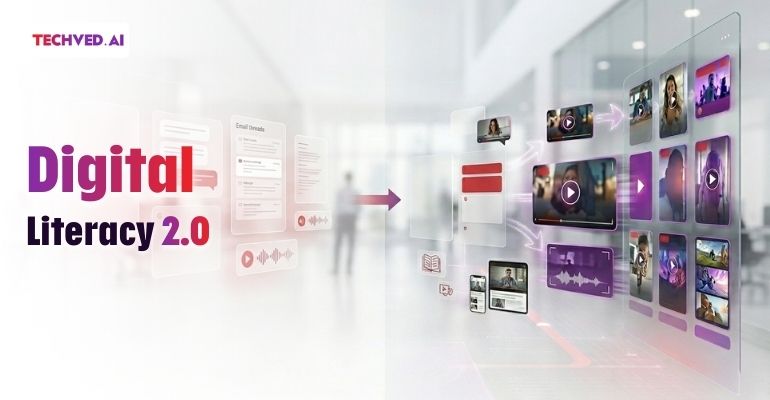
A company sends a 15-page policy document to all employees. Few weeks later, a survey reveals 80% skimmed it and only 30% understood the key changes. The alternative? A two-minute personalized video from the CEO explaining exactly what changed and why it matters. This is not about just replacing static PDFs with AI video. It results in increased engagement and retention.
This gap between information sent and information absorbed defines the challenge of modern communication. We have moved from information scarcity to information overload. Yet most organizations still communicate using methods designed for the print era. The shift to video-first communication is not just a trend. It is a fundamental upgrade to Digital Literacy 2.0.
The Evolution of Digital Communication
Traditional digital literacy meant reading emails, documents and chat messages. Today, modern professionals interact through video, voice, visuals and interactive formats. This transformation is driven by Multimodal communication supported by multimodal AI systems.
In this environment, AI-powered video communication becomes the new language of digital interaction. Instead of long explanations, organizations deliver clear and easily understandable visual experiences.
This shift marks the beginning of true digital communication transformation. At TECHVED AI, we help enterprises transition from static communication formats to scalable, AI-powered video-first ecosystems.
Why Video vs Document-Based Communication Wins
The evidence is overwhelming:
Retention- Viewers retain 95% of video messages versus 10% of text. Multimodal communication engages multiple cognitive pathways simultaneously.
Speed- Complex explanations that consume 20 minutes of reading require 3 minutes of demonstration. Video-first communication respects audience time.
Emotion- Tone, expression and pacing convey nuances that text alone cannot. Trust builds faster when humans see humans.
Accessibility- Visual learners, non-native speakers and time-pressed executives all benefit from AI-powered video communication formats.
Benefits of AI Video Avatars for Business Communication
Modern Video AI extends beyond recorded messages. Intelligent avatars deliver:
• Consistency across thousands of personalized interactions without human fatigue
• Scalability enabling one message to adapt to infinite recipient contexts through AI-Powered Personalization Services
• Availability providing 24/7 communication coverage across time zones
• Analytics tracking engagement, comprehension and conversion with granular precision
These benefits of AI video avatars for business communication transform customer onboarding, training and sales outreach from cost centers to growth engines.
AI-Powered Personalization: The Layer That Makes It Work
What separates effective video-first communication from a broadcast strategy is AI-powered personalization. When multimodal AI systems understand who is watching, what they need and where they are in a journey, every video becomes contextually intelligent.
This is where AI-Powered Personalization Services become a strategic investment rather than a feature add-on. Conversational video AI with objectives delivers personalization that drives retention, trust and conversion that static communication has never been able to deliver consistently.
The Business Imperative
Why invest in this shift now? Here are the important reasons-
Scarce Attention: Modern day attention span is very less. Video holds it better than any other medium.
Connection drives action: People respond to human faces and voices not just words.
Achievable Scale: Video AI Development Services now make personalized videos practical for thousands or millions of recipients.
Enhanced Analytics: Modern platforms track who watched, for how long, and what they understood .
The comparison of video vs document-based communication increasingly favors video for any message requiring genuine understanding or emotional connection. Documents remain useful for reference. Video excels at meaning.
The Competency Gap
Organizations mastering Digital Literacy 2.0 will capture disproportionate value. Those clinging to document-centric workflows will face problems like slower decision cycles, higher miscommunication costs, reduced talent attraction and diminished customer engagement
Video AI is not replacing text entirely. It is becoming the primary mode with text as supporting reference.
How TECHVED.AI Builds Video-First Enterprises
TECHVED.AI combines Video AI Development Services with deep expertise in AI-powered personalization to help organizations make the transition from document-heavy communication to scalable AI-powered video communication. From architecture to deployment, TECHVED.AI's Video AI development capability is built for enterprises that need both quality and scale.
Whether you are starting your digital communication transformation or scaling an existing multilingual communication strategy, TECHVED delivers the infrastructure and intelligence to make it work.
Ready to lead the video-first revolution? Partner with TECHVED.AI to build scalable, intelligent video communication systems.
FAQs
What is Digital Literacy 2.0?
Digital Literacy 2.0 is the competency to effectively create, consume and collaborate through video-first communication and multimodal communication formats powered by Video AI and intelligent systems.
How does AI-powered video communication differ from traditional video?
Traditional video is static and one-way. AI-powered video communication adapts to viewer context, enables interaction, personalizes content and learns from engagement to improve continuously.
What are Video AI Development Services?
These are professional services designing, building and deploying Video AI solutions including avatar creation, script automation, personalization engines and analytics platforms for enterprise communication needs.
What makes multimodal AI systems essential?
They unify text, voice, image and video processing into coherent communication experiences. This integration matches how humans naturally perceive and respond to information.
How quickly can organizations adopt video-first communication? Pilot programs launch within 4 to 6 weeks. Full digital communication transformation typically spans 3 to 6 months depending on organizational size and complexity.
Most Popular
How AI-Driven Video Content Is Revolutionising Business Communication
Synthetic Media Ethics: Maintaining Authenticity in the Age of Avatars
Why AI Is No Longer Optional for the Insurance Industry in 2026
Green AI for Enterprises: Building Energy-Efficient Intelligence at Scale
From Clicks to Conversations: How Video Messaging Is Replacing Traditional Funnels
Introducing HOLA VDA: The Future of Humanized AI Conversations
Reasoning-centric AI models vs “Predictive” AI: Why Enterprises are Shifting in 2026
Written By
Jay Anthony
Marketing Manager | TECHVED Consulting India Pvt. Ltd.
Jay Anthony holds expertise across a broad range of tech and innovation sectors. Driven by a passion for exploring ideas and sharing insight, Jay aims to craft work that is thoughtful, engaging and accessible. Whether diving into new subjects or reflecting on familiar ones, the goal is always to connect with readers and offer something meaningful.

Stay up-to-date with
all new market trends and
happenings
 #AIVideoContent #AIInBusiness #BusinessCommunication
How AI-Driven Video Content Is Revolutionising Business Communication
#SyntheticMedia #AIEthics #DigitalHumans #AIAvatars
Synthetic Media Ethics: Maintaining Authenticity in the Age of Avatars
#AgenticAI #InsuranceTech #AITrends2026 #InsuranceInnovation
Why AI Is No Longer Optional for the Insurance Industry in 2026
Ready To Transform?
Automate smarter. Create faster. Grow with AI.