 Back
BackBeyond the Call Center: How AI-Powered Virtual Assistants Are Redefining Insurance Policy Servicing
#InsuranceAI #PolicyServicing #VirtualDigitalAssistant #AgenticAI #InsurTech #TECHVED

Jay Anthony
7 August 2026 | 6 min read
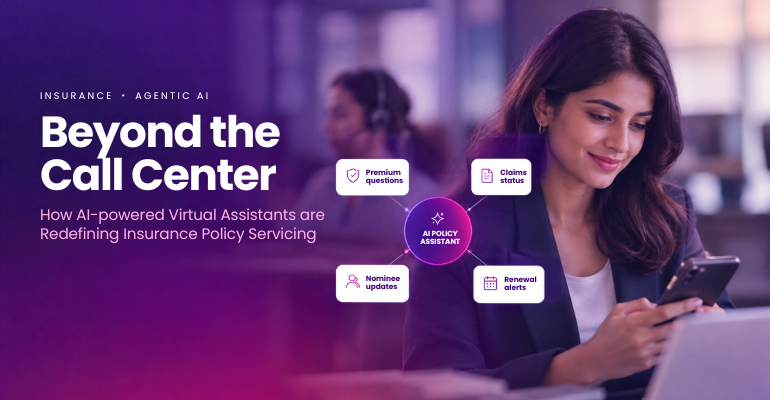
A policyholder wants to know why their premium changed this year. They call the insurer's helpline, wait eleven minutes, get transferred twice, and finally reach someone who has to look up their policy in a separate system before answering a question that should have taken thirty seconds. By the time they hang up, the interaction has cost more in frustration than the premium change itself.
This is the quiet failure point running through most insurance policy servicing today. The information exists. The systems exist. What's missing is a front line capable of accessing that information the moment a policyholder actually needs it.
Why Policy Servicing Is Under Pressure
Insurance has historically treated policy servicing as a cost center to be minimized rather than an experience to be designed. Call centers are staffed to handle volume, not necessarily speed or context. IVR systems route calls based on menu selections that rarely map cleanly to what a policyholder is actually asking.
Meanwhile, policyholder expectations have shifted. The same customer managing a bank account or a subscription service through a conversational interface increasingly expects the same from their insurer, and a phone queue increasingly feels like a step backward rather than a service.
The Shift Toward Conversational Policy Servicing
Across insurance, a shift is underway from channel-first servicing, where the policyholder is routed to whatever channel is available, toward intent-first servicing, where the system understands what's being asked and resolves it directly, regardless of channel.
Virtual digital assistants sit at the center of this shift. Rather than functioning as a scripted chatbot limited to FAQ-style answers, a well-implemented assistant can access policy data, understand context-specific questions, and complete servicing actions rather than simply describing them.
Where Traditional Policy Servicing Falls Short
Several recurring patterns show up across insurers still relying primarily on traditional servicing channels:
- Premium and coverage questions that require transferring between departments because no single channel has full context
- Policy document requests that take days to fulfill through manual back-office processes
- Renewal and payment reminders that are generic and easy to ignore, rather than personalized to the policyholder's actual situation
- Claims status inquiries that require a phone call because self-service portals aren't kept current in real time
- Long resolution times for simple servicing requests like updating a nominee or address, despite the underlying data change being trivial
What AI-Powered Policy Servicing Looks Like in Practice
Applied to insurance specifically, a capable virtual digital assistant changes several everyday servicing moments.
Answering Coverage and Premium Questions Directly
Instead of routing a policyholder to a department, the assistant pulls the relevant policy data and answers the specific question, including explaining why a premium changed based on the actual factors involved.
Completing Servicing Actions, Not Just Describing Them
Updating a nominee, changing a payment method, or requesting a policy document becomes something the assistant completes within the conversation, rather than a request that gets logged for someone else to action later.
Providing Real-Time Claims Visibility
Rather than a static status page, the assistant can explain exactly where a claim stands, what's needed next, and realistic timelines based on the actual claim's progress.
Personalizing Renewal and Retention Conversations
Renewal reminders move from generic notices to conversations that reference the policyholder's actual coverage, claims history, and any changes worth flagging before they renew.
The Business Case for AI-Powered Policy Servicing
Insurers investing in conversational policy servicing are seeing returns beyond faster response times:
- Reduced call center volume, as routine servicing requests get resolved without ever reaching a human agent
- Higher first-contact resolution, since the assistant has full policy context rather than requiring escalation
- Improved renewal retention, driven by more relevant and timely policyholder communication
- Lower servicing cost per interaction, as automation absorbs high-volume, low-complexity requests
- Better policyholder satisfaction scores, particularly among segments accustomed to conversational digital experiences elsewhere
Policy Servicing in Action
Consider a policyholder who receives a renewal notice with an increased premium. In a traditional flow, this triggers a call, a hold queue, and an agent who has to look up the reason before explaining it, often after the policyholder has already grown frustrated or considered switching insurers.
With a conversational assistant, the same policyholder gets an immediate, specific explanation of what changed and why, along with an option to review coverage adjustments if the increase is a concern. The resolution that once took a phone call now takes a conversation of a few messages, and the policyholder never has to explain their situation to someone starting from zero.
The Future of Insurance Servicing
As AI-powered servicing matures, the insurers who benefit most won't be the ones who simply added a chatbot to their website, but the ones who rebuilt policy servicing around instant, contextual resolution as the default expectation, not the exception.
Conclusion
Insurance policy servicing has never had an information problem. It has had an access problem, where the right answer existed somewhere in the system but wasn't available at the moment a policyholder actually needed it. Conversational AI assistants close that gap, turning policy servicing from a queue to wait in into a conversation that resolves on the spot.
Platforms like TECHVED.AI's Virtual Digital Assistant are part of this shift, helping insurers turn routine policy servicing into fast, contextual conversations that reduce cost while improving the policyholder experience.
FAQs
Why is traditional insurance policy servicing often slow or frustrating?
Because most servicing channels are built around call volume and menu-based routing rather than direct access to policy context, forcing policyholders to repeat information and wait for escalation.
What makes a virtual digital assistant different from a standard insurance chatbot?
A virtual digital assistant can access real policy data and complete servicing actions directly, rather than only answering scripted FAQ-style questions.
Can AI assistants handle sensitive policy servicing actions like nominee changes?
Yes, when properly integrated with policy systems and built with appropriate verification steps, assistants can complete these actions securely within the conversation.
Does AI-powered servicing replace human agents entirely?
No. It absorbs high-volume, routine requests so human agents can focus on complex cases that genuinely require judgment and escalation.
How does conversational servicing improve renewal retention?
By replacing generic renewal notices with specific, contextual conversations that address a policyholder's actual coverage and concerns before they consider switching insurers.
Most Popular

How AI-Driven Video Content Is Revolutionising Business Communication
Synthetic Media Ethics: Maintaining Authenticity in the Age of Avatars
Why AI Is No Longer Optional for the Insurance Industry in 2026

Green AI for Enterprises: Building Energy-Efficient Intelligence at Scale
From Clicks to Conversations: How Video Messaging Is Replacing Traditional Funnels

Introducing HOLA VDA: The Future of Humanized AI Conversations

Digital Literacy 2.0: Navigating the Shift from Text to Video-First Communication
Written By
Jay Anthony
Marketing Head
He leads the marketing and outreach activities at TECHVED, driving integrated campaigns that build brand visibility and engage enterprise audiences across every channel.

Stay up-to-date with
all new market trends and
happenings
 #AIVideoContent #AIInBusiness #BusinessCommunication
How AI-Driven Video Content Is Revolutionising Business Communication
#SyntheticMedia #AIEthics #DigitalHumans #AIAvatars
Synthetic Media Ethics: Maintaining Authenticity in the Age of Avatars
#AgenticAI #InsuranceTech #AITrends2026 #InsuranceInnovation
Why AI Is No Longer Optional for the Insurance Industry in 2026
Ready To Transform?
Automate smarter. Create faster. Grow with AI.