 Back
BackHow to Implement AI Agents in Enterprise Workflows
#ImplementAIAgents #EnterpriseAI #AIDeployment #TECHVEDAI

Jay Anthony
28 May 2026 | 4 min read
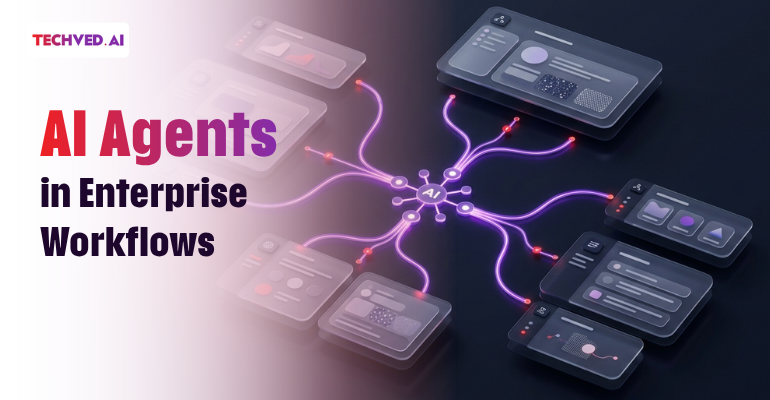
Your team spends hours every week moving data between systems. Approvals take days. Exception handling is manual. You know AI agents could help. But where do you start? What is the right path to implement AI agents in enterprise workflows without disrupting operations?
This question haunts every technology leader in 2026. The good news is that a proven framework exists. Follow these five steps to move from pilot to production with confidence.
What Does It Mean to Implement AI Agents in Enterprise?
To implement AI agents in enterprise means deploying autonomous systems that reason, decide, and act across your business workflows. Unlike traditional software which follows fixed rules, agentic AI solutions adapt to changing conditions and learn from outcomes.
Enterprise AI implementation is not about replacing one tool with another. It is about redesigning how work flows between humans and machines. The goal is autonomous workflows where agents handle routine decisions and humans focus on exception and strategy.
Step 1: Identify the Right Workflows
Not every process is ready for AI agents. Start with workflows that have:
- Clear triggers and defined outcomes
- Repetitive decisions with low exception rates
- Available structured data
- Measurable performance metrics
Good candidates: invoice approval under threshold, lead qualification, password reset, basic customer support tickets.
Poor candidates: creative strategy, sensitive negotiations, unstructured problem-solving.
Step 2: Map the Current State
Before deploying AI agents, document exactly how the workflow works today. Where are the bottlenecks? What decisions require human judgment? Which data sources does the workflow touch?
This mapping becomes your AI architecture strategy. It reveals integration points and decision boundaries.
Step 3: Design the Agent Architecture
AI system deployment requires a clear architecture:
Perception layer: How does the agent receive input? APIs? Event streams? User interfaces?
Reasoning layer: What rules and models guide agent decisions? Where does it use deterministic logic versus generative AI?
Action layer: What systems can the agent update? CRMs? ERPs? Communication tools?
Governance layer: How do you log decisions? Where is human override available?
AI workflow integration succeeds when the agent fits seamlessly into existing systems rather than requiring a complete overhaul.
Step 4: Pilot with Guardrails
Start small. Choose one workflow. Deploy the agent in "shadow mode" where it recommends actions but does not execute. Measure its accuracy. Refine its rules. Then move to supervised execution where a human approves every agent action. Only after proven accuracy, move to autonomous execution.
This phased enterprise AI implementation reduces risk and builds organizational confidence.
Step 5: Measure Scale and Iterate
Track these three vital categories of metrics:
- Efficiency: Time saved, volume processed, cost reduced
- Quality: Error rate, accuracy, compliance adherence
- Adoption: User satisfaction, escalation frequency, override rate
Use these metrics to expand the agent's autonomy boundaries over time. What started as supervised approval can become fully autonomous as trust builds.
Common Pitfalls to Avoid
Skipping governance: Agents without audit trails create compliance risk. Always build logging and oversight first.
Over-automating: Not every decision should be automated. Keep humans in the loop for high-stakes or ambiguous cases.
Neglecting change management: Teams resist agents they do not understand. Invest in training and transparent communication.
The TECHVED. AI Approach
Implementing AI agents in enterprise workflows requires specialized expertise in AI deployment strategy and AI implementation services. TECHVED.AI delivers agentic AI solutions tailored to your industry and processes.
We guide you from workflow identification to production deployment. Our enterprise AI implementation framework ensures governance, security, and measurable ROI at every stage.
Ready to implement AI agents in your enterprise? Partner with TECHVED.AI to start your autonomous workflow journey.
FAQs
How do you Implement AI Agents in Enterprise workflows?
You Implement AI Agents in Enterprise workflows by mapping high-value processes and designing governance frameworks and integrating with existing systems through APIs and deploying pilots before scaling to full autonomous workflows.
What is AI deployment strategy?
AI deployment strategy is the structured plan for moving autonomous systems from concept to production including discovery design development deployment and continuous evolution phases.
How does AI workflow integration work?
AI workflow integration connects autonomous agents to existing business systems through APIs and data pipelines enabling seamless handoffs between human and machine tasks.
What is AI architecture strategy?
AI architecture strategy defines the technical and organizational foundations for autonomous systems including data infrastructure governance monitoring and integration patterns.
Why are AI implementation services essential?
AI implementation services provide proven methodology change management expertise and technical depth that reduce deployment risk and accelerate time to value.
Most Popular
How AI-Driven Video Content Is Revolutionising Business Communication

Synthetic Media Ethics: Maintaining Authenticity in the Age of Avatars
Why AI Is No Longer Optional for the Insurance Industry in 2026
Green AI for Enterprises: Building Energy-Efficient Intelligence at Scale
From Clicks to Conversations: How Video Messaging Is Replacing Traditional Funnels
Introducing HOLA VDA: The Future of Humanized AI Conversations

Digital Literacy 2.0: Navigating the Shift from Text to Video-First Communication
Written By
Jay Anthony
Marketing Manager | TECHVED Consulting India Pvt. Ltd.
Jay Anthony holds expertise across a broad range of tech and innovation sectors. Driven by a passion for exploring ideas and sharing insight, Jay aims to craft work that is thoughtful, engaging and accessible. Whether diving into new subjects or reflecting on familiar ones, the goal is always to connect with readers and offer something meaningful.

Stay up-to-date with
all new market trends and
happenings
 #AIVideoContent #AIInBusiness #BusinessCommunication
How AI-Driven Video Content Is Revolutionising Business Communication
#SyntheticMedia #AIEthics #DigitalHumans #AIAvatars
Synthetic Media Ethics: Maintaining Authenticity in the Age of Avatars
#AgenticAI #InsuranceTech #AITrends2026 #InsuranceInnovation
Why AI Is No Longer Optional for the Insurance Industry in 2026
Ready To Transform?
Automate smarter. Create faster. Grow with AI.