 Back
BackReducing Operational Risk: Real-Time Monitoring and Autonomous Response
#AIRealTimeMonitoring #OperationalRisk #IncidentResponseAutomation #AnomalyDetection #TECHVEDAI

Jay Anthony
25 June 2026 | 6 min read
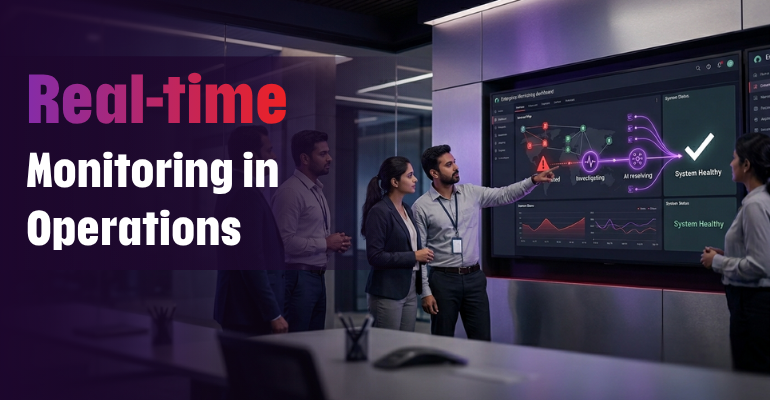
A payment gateway slows at 11:47pm on a Friday. Nobody notices until Monday morning when the finance team finds 94 failed transactions. The system logged the anomaly at 11:47pm. The alert went to an inbox that no one checked over the weekend. Four thousand customers saw error messages. The root cause took three hours to diagnose. Every part of that failure was preventable.
This is what AI real-time monitoring is built to prevent. Not by adding more dashboards for humans to check but by deploying real-time anomaly detection enterprise systems that identify deviations, assess their significance and trigger autonomous responses before the impact compounds.
What Is AI Real-Time Monitoring
AI real-time monitoring uses artificial intelligence to continuously observe systems, processes, and data streams for anomalies, risks, or performance deviations. Unlike traditional monitoring which checks periodically or alerts only after failures, AI-powered systems work 24/7. They learn normal patterns, flag deviations instantly and often act without human intervention.
Incident response automation is the natural extension. When the AI detects a risk, it doesn't just notify. It executes predefined responses. It isolates affected systems, reroutes workflows and escalates only when necessary. This is operational risk management transformed from reactive to proactive.
The Problem with Traditional Monitoring
Traditional approaches to operational risk management are fundamentally reactive. Teams monitor dashboards. They respond to alerts and investigate after incidents. This model breaks in modern complex environments.
The costs are staggering. Nearly all organizations (99%) report financial losses from AI-related risks, with nearly two-thirds (64%) suffering losses exceeding US$1 million. On average, financial losses are estimated at US$4.4 million per organization. The most common risks include non-compliance with AI regulations (57%), negative impacts to sustainability goals (55%) and biased outputs (53%).
How AI Real-Time Monitoring Transforms Risk Management
Real-time anomaly detection is the foundation. AI models learn what "normal" looks like for your systems. They monitor performance metrics, transaction patterns, and behavioral signals continuously. When something deviates, they flag it instantly.
Proactive AI maintenance extends this to physical assets. According to Deloitte's research, predictive maintenance delivers: 35–45% reduction in downtime, 70–75% elimination of unexpected breakdowns, and 25–30% reduction in maintenance costs. One major tech company reduced unplanned downtime by 30% within one year of implementing AI monitoring.
Incident response automation closes the loop. Once an anomaly is detected, AI-driven automation acts. The SODO report found that 37% of organizations with AI-driven incident response have improved operational efficiency and reduced downtime. Resolution speeds increase dramatically. Organizations using GenAI in IT service management save a cumulative 323,343 work hours through faster incident resolution. The top 10 AI adopters achieved a 54.3% improvement in resolution time, dropping from nearly 51 hours per incident to just over 23 hours.
Real-World Impact Across Industries
The results are measurable across sectors:
- Manufacturing: Prescriptive AI implementations achieve an average 38% reduction in unplanned downtime and a 22% increase in overall equipment effectiveness. AI predictive maintenance reduces infrastructure failures by 73% through continuous monitoring and early detection.
- Financial Services: Firms using AI in compliance are 2.2 times more likely to report high-quality data. Over half of compliance leaders (53%) now report AI has improved their programs' efficiency.
- Security: AI monitoring identifies approximately 210,000 potentially unsafe or non-compliant AI events daily, with 7% of all monitored AI-agent interactions triggering security or compliance anomaly detections.
- IT Operations: 78% of organizations using AI-powered platforms saw improved resilience in digital operations year-over-year. Enterprises using integrated AI workflows save 20 hours per employee per month and cut fraud by up to 95%.
The Governance Imperative
Powerful monitoring requires strong governance. Companies with real-time monitoring are 34% more likely to see revenue growth improvements and 65% more likely to see improved cost savings. Yet only 28% of firms test or validate AI outputs, revealing that oversight still lags. Effective operational risk management demands both the technology and the governance to use it responsibly.
How TECHVED.AI Builds Real-Time Monitoring Intelligence
TECHVED.AI designs AI real-time monitoring systems built for the complexity of enterprise operational environments. Every real-time operational intelligence platform TECHVED.AI deploys combines real-time anomaly detection enterprise capabilities with incident response automation and proactive AI maintenance models, giving operations and risk teams the intelligence they need to stop treating downtime as inevitable and start treating it as avoidable.
Ready to move from reactive to proactive risk management? Partner with TECHVED.AI to deploy AI real-time monitoring today.
FAQs
What is AI real-time monitoring?
AI real-time monitoring is the continuous automated observation of systems, data flows and processes through AI models that detect deviations, classify their severity and trigger incident response automation without human intervention. It differs from traditional monitoring by replacing the alert-and-wait model with detect-and-act, enabling reducing downtime with AI monitoring at enterprise scale.
What is real-time anomaly detection in enterprise systems?
Real-time anomaly detection enterprise systems identify deviations from expected behavioral patterns across infrastructure, applications and data environments as they occur. They feed directly into AI-driven operational risk management workflows, providing the signal precision needed for autonomous response rather than alert fatigue.
How does incident response automation reduce operational risk?
Incident response automation reduces operational risk management exposure by eliminating the delay between detection and response. When AI real-time monitoring classifies an incident, predefined autonomous actions execute immediately, isolating failures and initiating recovery before human review, cutting mean time to resolution by a measurable margin.
What is proactive AI maintenance?
Proactive AI maintenance uses historical failure pattern data to identify the conditions that precede incidents, enabling intervention before the threshold breach. It is the predictive layer within a real-time operational intelligence platform that shifts enterprise operations from reactive firefighting to pre-emptive risk elimination.
How does AI for compliance and risk monitoring work?
AI for compliance and risk monitoring applies AI real-time monitoring to regulatory and governance environments, flagging access control deviations, data handling anomalies and policy violations as they occur rather than surfacing them in periodic audit cycles. It creates a continuous, always-on compliance layer with audit-ready logs generated automatically for every detected event.
Most Popular
How AI-Driven Video Content Is Revolutionising Business Communication
Synthetic Media Ethics: Maintaining Authenticity in the Age of Avatars
Why AI Is No Longer Optional for the Insurance Industry in 2026
Green AI for Enterprises: Building Energy-Efficient Intelligence at Scale
From Clicks to Conversations: How Video Messaging Is Replacing Traditional Funnels
Introducing HOLA VDA: The Future of Humanized AI Conversations
Digital Literacy 2.0: Navigating the Shift from Text to Video-First Communication
Written By
Jay Anthony
Marketing Manager | TECHVED Consulting India Pvt. Ltd.
Jay Anthony holds expertise across a broad range of tech and innovation sectors. Driven by a passion for exploring ideas and sharing insight, Jay aims to craft work that is thoughtful, engaging and accessible. Whether diving into new subjects or reflecting on familiar ones, the goal is always to connect with readers and offer something meaningful.

Stay up-to-date with
all new market trends and
happenings
 #AIVideoContent #AIInBusiness #BusinessCommunication
How AI-Driven Video Content Is Revolutionising Business Communication
#SyntheticMedia #AIEthics #DigitalHumans #AIAvatars
Synthetic Media Ethics: Maintaining Authenticity in the Age of Avatars
#AgenticAI #InsuranceTech #AITrends2026 #InsuranceInnovation
Why AI Is No Longer Optional for the Insurance Industry in 2026
Ready To Transform?
Automate smarter. Create faster. Grow with AI.