 Back
BackVoice AI in CX: How Enterprises Are Replacing IVR with Intelligent Agents
#VoiceAI #CustomerExperience #IVRReplacement #ContactCenterAutomation #TECHVEDAI

Jay Anthony
12 May 2026 | 6 min read
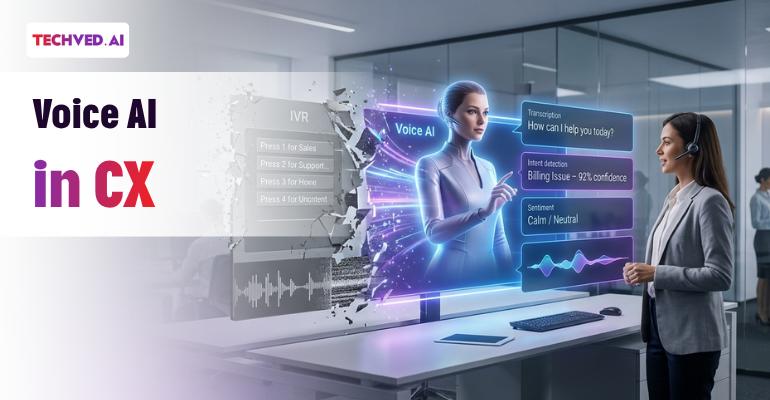
Imagine you are in a rush and need to change a flight or check a bank balance. You call the support line only to be met with: "Press 1 for English... Press 2 for billing... Please enter your account number followed by the pound key." After five minutes of navigating a digital maze you finally reach a human only to be asked for the same account number again.
This is the IVR experience that millions of customers still face daily. And it is precisely the gap that voice AI in customer experience is designed to close. Not by adding a layer on top of traditional call infrastructure but by replacing the rigid, frustrating architecture of IVR entirely with AI voice agents that listen, understand, reason and resolve in real time.
What Is Voice AI in Customer Experience?
Voice AI in customer experience refers to the deployment of conversational AI voice systems that handle spoken customer interactions autonomously. Unlike IVR, which routes callers through pre-defined menus, voice AI agents process natural language, understand caller intent and respond dynamically to what the customer actually says rather than forcing them to conform to a limited set of options.
These agents connect to CRM systems, knowledge bases and operational platforms in real time, enabling them to retrieve account information, process requests and resolve queries end-to-end. When a situation exceeds their defined scope, they escalate to a human agent with full context transferred, so the customer never has to repeat themselves.
Why IVR Replacement AI Is Overdue
Traditional IVR was designed in the 1980s. Technology has changed and so has customer expectations. But IVR has not. Studies show 81% of customers are frustrated by IVR systems. Over 60% would switch brands after a single bad phone experience. The cost of poor phone service is brand defection.
IVR replacement AI solves these problems:
No menus to memorize: Speak naturally. The agent understands.
No repetition: The AI remembers what you said.
No dead ends: The agent routes you appropriately.
24/7 availability: Intelligent agents work every hour.
Conversational AI Voice in Action
Conversational AI voice agents handle increasingly complex requests. A customer calls an airline. "I need to change my flight to tomorrow afternoon." The agent checks availability, explains fare differences, processes the change and sends a confirmation. All without a single button press.
Current capabilities include:
Intent recognition: Understanding what the caller wants even when phrased differently
Sentiment analysis: Detecting frustration and adjusting tone or escalating
Transaction completion: Processing payments, bookings, and account changes
Context retention: Remembering information across the conversation
Contact Center Automation: Beyond Call Deflection
The traditional case for IVR replacement AI has been cost: deflect calls, reduce agent headcount and cut operational expense. That framing undersells what contact center automation through voice AI agents actually delivers.
Contact center automation through voice AI agents delivers measurable results:
Reduced wait times: AI handles multiple calls simultaneously. No queues for routine requests.
Lower costs: Each automated call saves $5-10 compared to human handling.
Higher customer satisfaction: Fast friction-free resolution earns higher CSAT scores.
Agent satisfaction: Human agents handle complex interesting calls not password resets.
Companies report 30-50% call deflection after implementing AI-powered customer support voice agents. That means thousands of calls per month never reach a human. Those humans focus on calls that truly need them.
The Technology Behind Voice AI
Modern voice AI agents combine several technologies. Automatic speech recognition converts speech to text. Natural language understanding extracts intent. Large language models generate responses. Text-to-speech creates natural voice output. The entire loop happens in under a second.
Leading customer experience solutions now offer AI-driven customer engagement across phone, chat, and video. The customer chooses the channel. The AI works across all of them.
From IVR to Intelligent Assistant
The shift is from system-centric to customer-centric. IVR forced customers to adapt to the system. Voice AI adapts to the customer. Speak slowly or quickly. Use different words. Interrupt or pause. The intelligent agent follows.
Enterprises making this switch report dramatic improvements. One telecom company reduced average handle time from 8 minutes to 2 minutes. A bank increased first-call resolution from 65% to 92%. A retailer saw customer effort score improve by 40 points.
The TECHVED.AI Approach
Deploying voice AI in customer experience requires expertise in speech technology integration and workflow design. TECHVED.AI delivers contact center automation solutions that replace legacy IVR with conversational AI voice agents.
We build AI voice agents tailored to your industry and customer needs. Our customer experience solutions integrate with your existing systems. The result is faster service, happier customers and lower costs.
Ready to retire your IVR? Partner with TECHVED.AI to deploy intelligent voice agents today.
FAQs
How does voice AI differ from traditional IVR?
Traditional IVR forces callers through button-press menus. Voice AI in customer experience uses AI voice agents that understand natural speech. Callers say what they need. The agent understands and acts. No menus. No frustration.
Can voice AI handle complex customer requests?
Yes. Modern conversational AI voice agents process payments, change bookings, update accounts, and answer complex questions. They only escalate to humans when truly necessary.
What is the ROI of replacing IVR with voice AI?
Companies report 30-50% call deflection, 50-75% reduction in handle time, and $5-10 savings per automated call. Most deployments pay for themselves within 6-12 months.
Is voice AI secure for sensitive transactions?
Yes. AI voice agents include authentication via voice biometrics, PIN verification, and multi-factor authentication. Security equals or exceeds traditional IVR.
Most Popular
How AI-Driven Video Content Is Revolutionising Business Communication
Synthetic Media Ethics: Maintaining Authenticity in the Age of Avatars
Why AI Is No Longer Optional for the Insurance Industry in 2026

Green AI for Enterprises: Building Energy-Efficient Intelligence at Scale

From Clicks to Conversations: How Video Messaging Is Replacing Traditional Funnels
Introducing HOLA VDA: The Future of Humanized AI Conversations
Digital Literacy 2.0: Navigating the Shift from Text to Video-First Communication
Written By
Jay Anthony
Marketing Manager | TECHVED Consulting India Pvt. Ltd.
Jay Anthony holds expertise across a broad range of tech and innovation sectors. Driven by a passion for exploring ideas and sharing insight, Jay aims to craft work that is thoughtful, engaging and accessible. Whether diving into new subjects or reflecting on familiar ones, the goal is always to connect with readers and offer something meaningful.

Stay up-to-date with
all new market trends and
happenings
 #AIVideoContent #AIInBusiness #BusinessCommunication
How AI-Driven Video Content Is Revolutionising Business Communication
#SyntheticMedia #AIEthics #DigitalHumans #AIAvatars
Synthetic Media Ethics: Maintaining Authenticity in the Age of Avatars
#AgenticAI #InsuranceTech #AITrends2026 #InsuranceInnovation
Why AI Is No Longer Optional for the Insurance Industry in 2026
Ready To Transform?
Automate smarter. Create faster. Grow with AI.