 Back
BackAI Co-Workers in Enterprises: Redefining Roles, Not Just Automating Tasks
#AgenticAI #AICo-Workers #AIWorkforceAutomation #EnterpriseAI

Jay Anthony
30 April 2026 | 5 min read
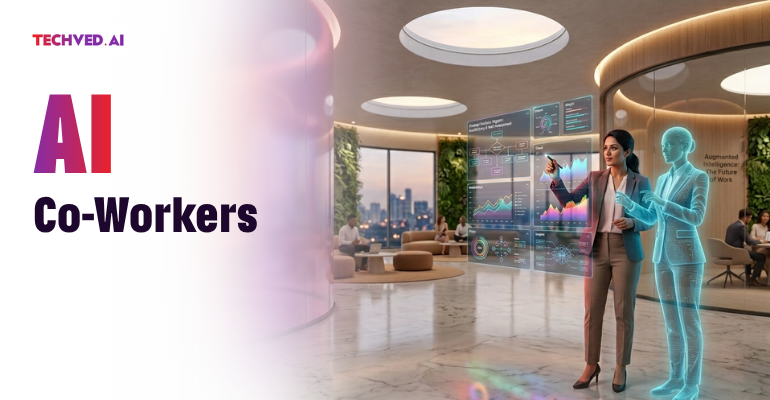
A marketing manager just starts her day. Meanwhile, her Agentic AI co-worker has already analyzed campaign data from overnight and prepared three optimization options with projected outcomes. The manager reviews, chooses one and approves it. The AI executes the changes instantly. The manager spends her morning on creative strategy, not data crunching.
This is what Agentic AI looks like in practice. Not a replacement for the marketing manager but a capable, always-on AI co-worker that handles the volume, so the human handles the value. The conversation around AI workforce automation has been dominated by fear of replacement. The enterprises making the right moves are focused on something more interesting: role redefinition.
What Makes Agentic AI a Co-Worker, Not Just a Tool?
Most automation tools execute fixed instructions. Agentic AI operates differently. These are systems that independently plan, reason and execute multi-step tasks with minimal human intervention. They do not wait for a prompt at every stage of the workflow.
This is why AI co-workers in enterprises is not hyperbole. A well-designed Agentic AI system participates in workflows the same way a junior colleague would: with a defined scope, a clear accountability structure and the capacity to flag when a decision exceeds its authority. The difference is it never calls in sick, never loses context between shifts and can run a thousand processes simultaneously.
How Agentic AI Redefines Roles Across Enterprise Functions
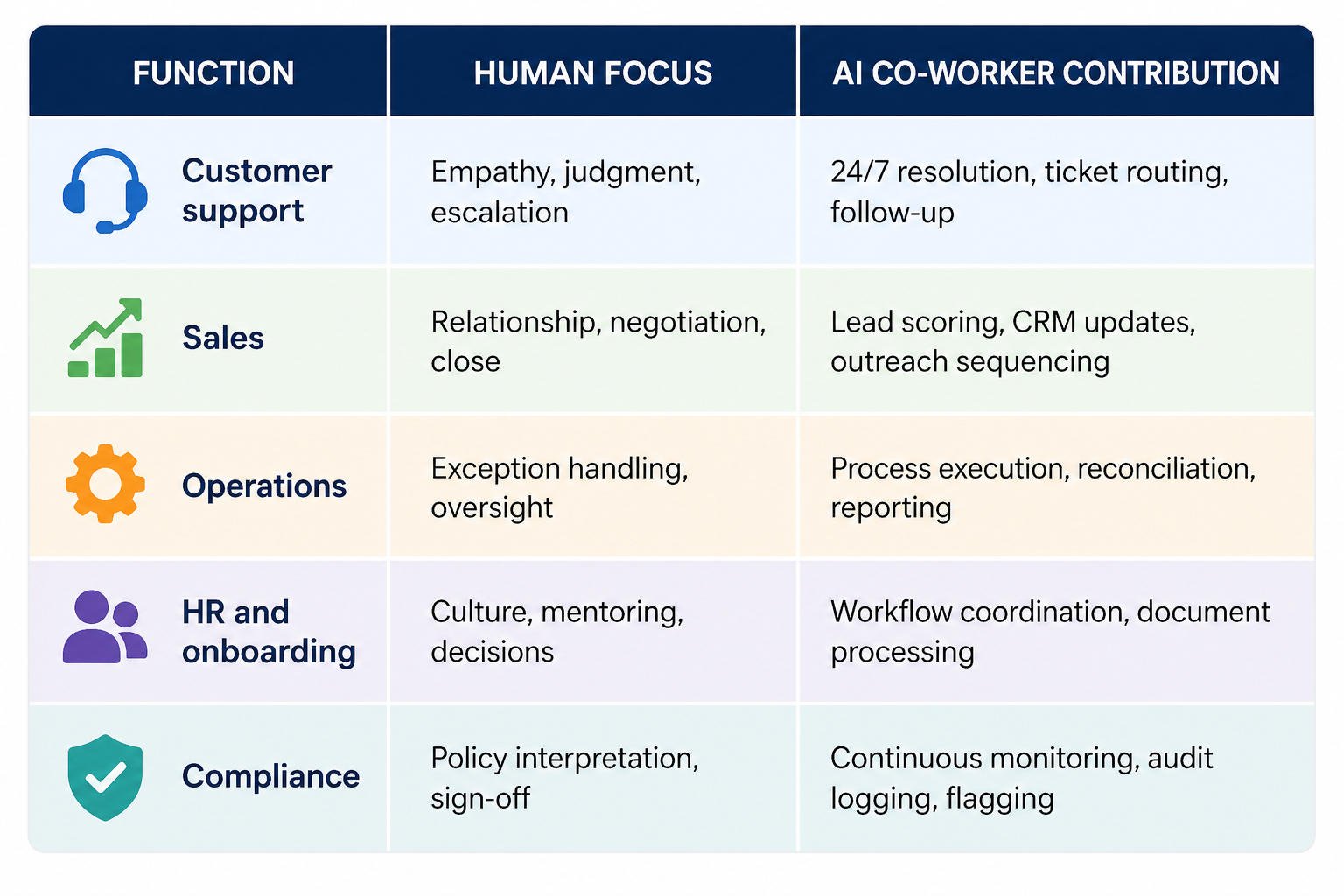
What humans focus on and what Agentic AI co-workers handle across five enterprise functions:
The Human-AI Balance
Maintaining AI human balance is a critical success factor. Enterprises that deploy AI workforce automation without redesigning roles create frustration. It results in humans feeling monitored and AI being underutilized.
The right balance follows a simple principle: AI handles the routine and the repeatable. Humans handle the exceptional and the emotional.
Agentic AI handles decisions within clear boundaries. Humans handle decisions requiring ethics, empathy or organizational nuance.
This balance is not static. As agentic AI services mature, boundaries shift. Roles evolve. The enterprise must embrace continuous redesign.
Architecting for Co-Worker Success
Enterprise agentic AI architecture must support human-AI collaboration, not just automation. Key design principles include:
- Transparent Handoffs: Humans and AI share complete context. When a human takes over from AI, the human sees every step and action taken by AI.
- Shared Goals: AI co-workers optimize for the same metrics as human teams. No conflicting incentives.
- Feedback Loops: Humans train AI through natural work. Every override and correction improves future AI performance.
- Role Clarity: Every employee knows what their AI co-worker does and what remains their responsibility.
Ethical AI Avatars as Team Members
Ethical AI avatars represent a new category of co-worker. These digital team members have persistent identities. They learn over time and build relationships with human colleagues.
A customer support AI avatar remembers past interactions with each agent. It learns which agents prefer certain escalation styles. It adapts its communication to reduce friction. Over months it becomes a trusted partner rather than being just a tool.
Ethical considerations are paramount. AI co-workers must disclose their nature. They cannot deceive humans about their capabilities. They must respect privacy and data boundaries. Enterprise AI transformation succeeds only when trust underpins every human-AI interaction.
Strategic Implementation Roadmap
AI strategy consulting helps enterprises navigate this transition. A proven roadmap includes:
Phase 1: Role Auditing
Map every role's tasks. Identify which are routine, which require judgment and which need human connection. This reveals where Agentic AI adds value.
Phase 2: Co-Worker Design
Design AI co-workers as partners not overlords. Give them names, personas and clear responsibilities. Train humans on how to work with them effectively.
Phase 3: Continuous Evolution
Measure role satisfaction alongside productivity. Adjust boundaries as AI capabilities grow. Keep humans in the loop for decisions that matter.
How TECHVED.AI Designs Human-Centered Agentic Systems
Building effective AI co-workers in enterprises requires deep expertise in both technology and organizational change. TECHVED.AI delivers agentic AI services that respect the AI human balance.
We design enterprise agentic AI architecture with collaboration at its core. Our ethical AI avatars become trusted team members, not faceless automations. We help you redefine roles instead of just automating tasks.
The enterprises that master human-AI collaboration will outperform those that merely replace humans with bots. The difference is design. The difference is TECHVED.AI
Ready to build AI co-workers that elevate your teams? Partner with TECHVED.AI to start your enterprise AI transformation.
FAQs
What is the difference between traditional automation and agentic AI?
Traditional automation follows fixed rules. Agentic AI sets its own steps to reach a goal, adapts when conditions shift and handles ambiguity without breaking down.
Are AI co-workers replacing human jobs?
Not replacing but reshaping. AI co-workers in enterprises handle high-volume, low-judgment tasks so humans can focus on strategy, creativity and oversight.
What does AI strategy consulting actually involve?
AI strategy consulting aligns your AI agents with business goals, ensures regulatory compliance and integrates agents into existing systems without disruption.
How do we maintain ethical standards with AI co-workers?
Ethical AI avatars built with transparency, disclosure and privacy protection maintain trust. Clear boundaries and human override capabilities ensure accountability. Regular audits prevent drift.
What is the first step to introducing AI co-workers?
Conduct a role audit to identify routine tasks suitable for Agentic AI. Then design a pilot co-worker for one team. Measure both productivity and employee satisfaction. Scale based on results.
Most Popular
How AI-Driven Video Content Is Revolutionising Business Communication
Synthetic Media Ethics: Maintaining Authenticity in the Age of Avatars
Why AI Is No Longer Optional for the Insurance Industry in 2026
Green AI for Enterprises: Building Energy-Efficient Intelligence at Scale
From Clicks to Conversations: How Video Messaging Is Replacing Traditional Funnels
Introducing HOLA VDA: The Future of Humanized AI Conversations
Digital Literacy 2.0: Navigating the Shift from Text to Video-First Communication
Written By
Jay Anthony
Marketing Manager | TECHVED Consulting India Pvt. Ltd.
Jay Anthony holds expertise across a broad range of tech and innovation sectors. Driven by a passion for exploring ideas and sharing insight, Jay aims to craft work that is thoughtful, engaging and accessible. Whether diving into new subjects or reflecting on familiar ones, the goal is always to connect with readers and offer something meaningful.

Stay up-to-date with
all new market trends and
happenings
 #AIVideoContent #AIInBusiness #BusinessCommunication
How AI-Driven Video Content Is Revolutionising Business Communication
#SyntheticMedia #AIEthics #DigitalHumans #AIAvatars
Synthetic Media Ethics: Maintaining Authenticity in the Age of Avatars
#AgenticAI #InsuranceTech #AITrends2026 #InsuranceInnovation
Why AI Is No Longer Optional for the Insurance Industry in 2026
Ready To Transform?
Automate smarter. Create faster. Grow with AI.