 Back
BackFrom IVR to MVA: The Next Evolution of Conversational Support
#ConversationalAIAgent #IVRtoMVA #MultimodalVoiceAgent #NextGenCXAutomation #TECHVEDAI

Jay Anthony
15 June 2026 | 4 min read
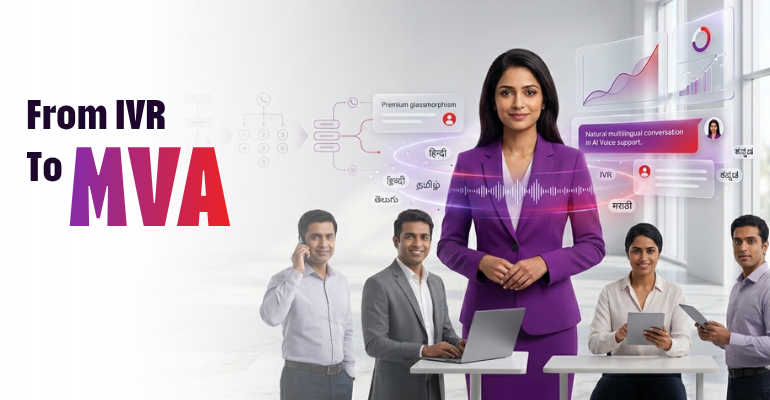
You call an airline to change a flight. A robotic voice says "Press 1 for reservations. Press 2 for existing bookings." You press 2. "Enter your 10-digit confirmation number." You fumble for your phone and end up entering it wrong two times. Hold music. Finally an agent asks for the same number again. This is IVR. And it is failing customers everywhere.
Now imagine the same call with a conversational AI agent. You say "I need to change my flight tomorrow to a later time." The agent understands. It checks availability. It explains fare differences. It processes the change. No menus. No hold. No repetition. This is the Voice Agent (MVA). And it is the future of customer experience beyond IVR.
What Is MVA?
MVA stands for Multilingual Voice Agent. It is the evolution beyond traditional automated customer service into systems that combine voice, visual and contextual intelligence. Unlike IVRs that force callers into preset paths, MVAs engage in natural dialogue.
Key differences from IVR:
- Natural language: Speak normally not "press or say"
- Context memory: Remembers what you said earlier in the call
- System integration: Books, refunds, updates without transfer
- Emotional intelligence: Detects frustration and adapts tone
This is next-gen customer support automation that treats customers as humans, not inputs.
Why IVR Is Dying
IVR was designed in the 1980s for a world of touch-tones and limited computing. It fails modern expectations:
- 81% of customers are frustrated by IVR systems
- 60% would switch brands after a single bad phone experience
- Average call time with IVR is 8-12 minutes vs 2-4 minutes with conversational AI
- First-call resolution drops 40% when IVR cannot understand non-standard requests
Replacing IVR with conversational AI is not a luxury. It is a competitive necessity. Customers who experience MVA never want to go back.
Key Benefits of Multimodal Voice Agents
Multimodal voice agent benefits extend across the enterprise:
- Speed: Average handling time drops 60-70% as customers speak naturally instead of navigating menus
- Accuracy: Intent recognition exceeds 95% compared to 60-70% for IVR keyword spotting
- Scalability: One MVA handles unlimited concurrent calls. No busy signals. No queues.
- Satisfaction: CSAT scores increase 30-40 points when customers bypass IVR frustration
Automated customer service with conversational AI feels anything but automated. The agent sounds human, understands context and solves problems rather than just routes calls.
How MVA Handles Complex Requests
Traditional IVR fails at complexity. A customer with multiple issues (change address, dispute a charge, ask about rewards) must hang up and call again for each. An MVA handles all three in one call.
Reasoning-centric AI enables the agent to:
Identify primary intent: The agent determines the most urgent request first
Hold state: While processing one request, it remembers the others
Sequence actions: It completes tasks in logical order without customer repetition
Confirm completion: It summarizes all actions before ending the call
This is next-gen customer support automation that mirrors how human agents work.
The Migration Path from IVR to MVA
Transitioning requires strategy not just technology swap:
Phase 1: Analyze IVR call flows
Identify which requests drive the most volume and frustration. Prioritize these for MVA handling.
Phase 2: Train the conversational AI agent
Feed it call transcripts. Teach it your products and policies. Test with real customers.
Phase 3: Parallel run
Keep IVR active while MVA handles a percentage of calls. Measure performance difference.
Phase 4: Gradual sunset
Shift volume to MVA. Keep simple IVR menu for edge cases. Eventually retire legacy system.
The TECHVED.AI Advantage
Implementing a conversational AI agent requires expertise in speech recognition, natural language understanding, and system integration. TECHVED.AI delivers intelligent voice response solutions that replace IVR with MVA.
Our conversational AI agent platform integrates with your CRM, knowledge base, and workflow systems. We build reasoning-centric AI that understands your customers and resolves their issues end to end. The result is automated customer service that customers actually enjoy.
Ready to retire your IVR? Partner with TECHVED.AI to deploy next-gen conversational AI agents.
FAQs
What is a Conversational AI agent?
A Conversational AI agent is an intelligent system that engages customers through natural dialogue across voice and text and visual channels, understanding intent and reasoning through problems rather than following rigid scripts.
How does MVA differ from IVR?
IVR forces callers through preset menu trees. MVA uses reasoning-centric AI to understand context, diagnose issues and generate dynamic responses tailored to individual situations.
What are multimodal voice agent benefits?
They include natural conversation, visual context sharing, cross-channel memory, emotional intelligence and seamless human handoff with full context preservation.
What is next-gen customer support automation?
It is intelligent automation that resolves issues autonomously through understanding and reasoning rather than merely routing calls or deflecting inquiries.
How does replacing IVR with conversational AI affect costs?
It reduces average handle time by 40% to 60%, increases first-contact resolution and improves customer satisfaction scores while lowering operational expenditure.
Most Popular
How AI-Driven Video Content Is Revolutionising Business Communication
Synthetic Media Ethics: Maintaining Authenticity in the Age of Avatars
Why AI Is No Longer Optional for the Insurance Industry in 2026
Green AI for Enterprises: Building Energy-Efficient Intelligence at Scale
From Clicks to Conversations: How Video Messaging Is Replacing Traditional Funnels
Introducing HOLA VDA: The Future of Humanized AI Conversations
Digital Literacy 2.0: Navigating the Shift from Text to Video-First Communication
Written By
Jay Anthony
Marketing Manager | TECHVED Consulting India Pvt. Ltd.
Jay Anthony holds expertise across a broad range of tech and innovation sectors. Driven by a passion for exploring ideas and sharing insight, Jay aims to craft work that is thoughtful, engaging and accessible. Whether diving into new subjects or reflecting on familiar ones, the goal is always to connect with readers and offer something meaningful.

Stay up-to-date with
all new market trends and
happenings
 #AIVideoContent #AIInBusiness #BusinessCommunication
How AI-Driven Video Content Is Revolutionising Business Communication
#SyntheticMedia #AIEthics #DigitalHumans #AIAvatars
Synthetic Media Ethics: Maintaining Authenticity in the Age of Avatars
#AgenticAI #InsuranceTech #AITrends2026 #InsuranceInnovation
Why AI Is No Longer Optional for the Insurance Industry in 2026
Ready To Transform?
Automate smarter. Create faster. Grow with AI.