 Back
BackWhat Is a Virtual Digital Agent (VDA)? How It Differs from Chatbots and AI Agents
#VirtualDigitalAgent #VDA #AICXStrategy #AIInCustomerExperience #TECHVEDAI

Jay Anthony
14 May 2026 | 5 min read
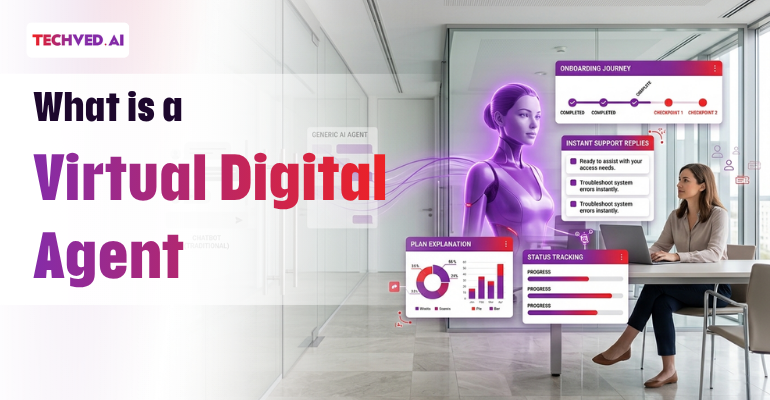
Your flight is cancelled. You open the airline app. A chatbot greets you. It offers three preset options. None match your situation. You type 'rebook with hotel voucher.' It replies: 'I did not understand. Please select from the menu.' You rage-quit and call the hotline, waiting 45 minutes.
Now imagine the same scenario. But this time, a digital representative appears on screen. She sees your booking, notices the weather disruption, apologizes sincerely and offers rebooking plus compensation based on your loyalty tier and past preferences. She remembers you dislike middle seats. She handles everything in one conversation.
That second interaction is a virtual digital agent (VDA). Not a chatbot. Not a generic AI agent. A purpose-built digital persona designed for deep, contextual, empathetic engagement.
What Is a Virtual Digital Agent (VDA)?
A virtual digital agent (VDA) is an AI-powered interface that presents as a lifelike avatar, capable of speaking, gesturing and responding through video as well as voice and text. It is built to handle high-trust, high-stakes customer interactions where tone, clarity and emotional resonance matter as much as resolution speed.
Unlike a chatbot which operates through rule-based text responses, or a backend AI agent which executes tasks across systems, a VDA combines both dimensions into a single human-like experience layer. It draws on AI customer insights and AI-driven analytics to personalize every interaction in real time, making AI in customer experience feel genuinely individual rather than automated.
VDA vs Chatbots vs AI Agents: The Key Differences
The confusion is understandable. All three talk to customers. But their capabilities differ dramatically.
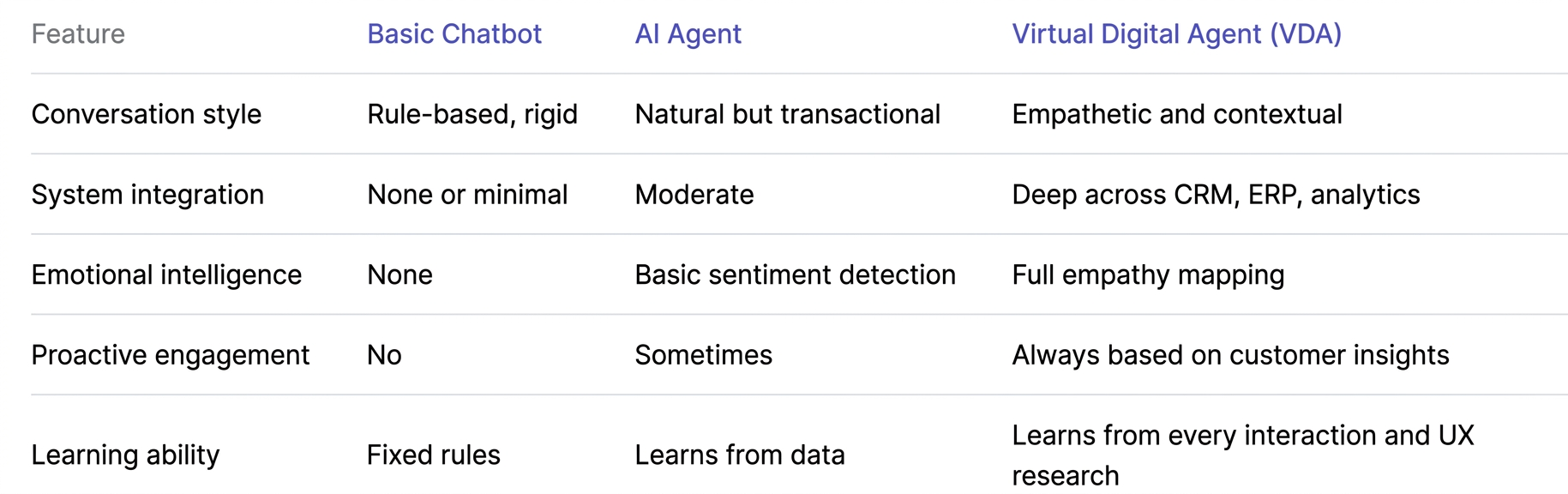
A chatbot follows scripted trees. An AI agent performs tasks autonomously. A virtual digital agent (VDA) builds relationships. It uses empathy mapping in UX to adjust tone and language. It applies AI personalization to tailor every response.
The VDA's Role in a Modern AI CX Strategy
A virtual digital agent (VDA) sits at the top of the CX interaction hierarchy. It is deployed where the customer relationship is most at risk or most valuable: high-value onboarding, sensitive complaint resolution, complex product explanation and renewal conversations where a flat, text-based experience would erode rather than build trust.
What makes a VDA strategically powerful is its ability to operate as a customer experience analytics layer simultaneously. Every interaction generates AI customer insights including sentiment signals, comprehension markers and behavioral patterns that feed back into UX Research and empathy mapping in UX frameworks. The VDA does not just deliver the experience. It informs how the experience is continuously improved.
The Anatomy of Intelligent CX
A VDA operates through integrated capabilities:
Empathy Mapping in UX- Through UX Research and sentiment analysis, the agent detects emotional states and adjusts tone dynamically. This is empathy mapping in UX at scale.
AI-Driven Analytics- Every conversation generates data analytics that improve future interactions. The agent learns preferences and anticipates needs.
Customer Experience Analytics- Leadership receives real-time visibility into interaction quality and emotional outcomes. Customer experience analytics transform from lagging indicators to live intelligence.
AI-Powered CX Through Deep Personalization
Where traditional automation segments audiences, a VDA understands individuals.
It accesses:
- Purchase history and service records
- Previous conversation context across channels
- Real-time behavioral signals and intent
- Predictive models for next-best-action
This creates AI customer insights that drive proactive engagement. The agent anticipates issues and intervenes with solutions.
TECHVED.AI partners with enterprises to deploy VDAs that align AI CX strategy with brand identity and operational reality.
Why AI in Customer Experience Needs the Human Touch
Technology that feels robotic creates distance. A virtual digital agent (VDA) bridges this gap by design.
It maintains consistent personality aligned with brand values. It expresses appropriate emotion without fabrication. It escalates to humans seamlessly when sensitivity demands it.
This balance is the core of modern AI-powered CX. Efficiency without empathy is merely cost-cutting. Empathy without efficiency is unsustainable. The VDA delivers both.
Why Enterprises Are Adopting VDAs
The business case is compelling. VDAs reduce support costs by 40-60%. They increase first-contact resolution beyond 85%. They boost customer satisfaction scores by 20-30 points. Most importantly, they scale empathy. Every customer gets the same attentive personalized service regardless of time or volume.
TECHVED.AI builds virtual digital agent (VDA) solutions tailored to your industry. Our agents integrate with your CRM, analytics platforms, and communication channels. We apply AI-driven analytics and customer experience analytics to create VDAs that feel human and deliver results.
Ready to move beyond chatbots? Partner with TECHVED to deploy empathy-driven virtual digital agents.
FAQs
What is a virtual digital agent (VDA)?
A virtual digital agent (VDA) is an AI-powered digital persona that engages customers through natural, emotionally intelligent, personalized interactions. It combines memory, empathy and task execution in a persistent brand representative.
How does a VDA differ from a chatbot?
Chatbots handle simple, scripted interactions. A VDA understands context, remembers history, adapts emotionally and manages complex, multi-turn relationships across sessions.
What role does AI-driven analytics play in VDA performance?
AI-driven analytics continuously analyze conversation data to improve response quality, predict customer needs and generate actionable AI customer insights for business strategy.
Why is empathy mapping in UX important for VDAs?
Empathy mapping in UX ensures the agent recognizes emotional states and adjusts its approach. This creates interactions that feel human rather than mechanical, building trust and loyalty.
How do VDAs improve customer experience analytics?
They capture granular interaction data including sentiment, resolution effectiveness and behavioral patterns. This enriches customer experience analytics beyond traditional survey-based measurement.
Most Popular
How AI-Driven Video Content Is Revolutionising Business Communication
Synthetic Media Ethics: Maintaining Authenticity in the Age of Avatars
Why AI Is No Longer Optional for the Insurance Industry in 2026

Green AI for Enterprises: Building Energy-Efficient Intelligence at Scale
From Clicks to Conversations: How Video Messaging Is Replacing Traditional Funnels
Introducing HOLA VDA: The Future of Humanized AI Conversations
Digital Literacy 2.0: Navigating the Shift from Text to Video-First Communication
Written By
Jay Anthony
Marketing Manager | TECHVED Consulting India Pvt. Ltd.
Jay Anthony holds expertise across a broad range of tech and innovation sectors. Driven by a passion for exploring ideas and sharing insight, Jay aims to craft work that is thoughtful, engaging and accessible. Whether diving into new subjects or reflecting on familiar ones, the goal is always to connect with readers and offer something meaningful.

Stay up-to-date with
all new market trends and
happenings
 #AIVideoContent #AIInBusiness #BusinessCommunication
How AI-Driven Video Content Is Revolutionising Business Communication
#SyntheticMedia #AIEthics #DigitalHumans #AIAvatars
Synthetic Media Ethics: Maintaining Authenticity in the Age of Avatars
#AgenticAI #InsuranceTech #AITrends2026 #InsuranceInnovation
Why AI Is No Longer Optional for the Insurance Industry in 2026
Ready To Transform?
Automate smarter. Create faster. Grow with AI.