 Back
BackAgentic VDA: Why Enterprises Are Shifting to Reasoning-Centric Assistants
#AgenticVDA #VirtualDigitalAssistant #EnterpriseAI #TECHVEDAI

Jay Anthony
18 June 2026 | 4 min read
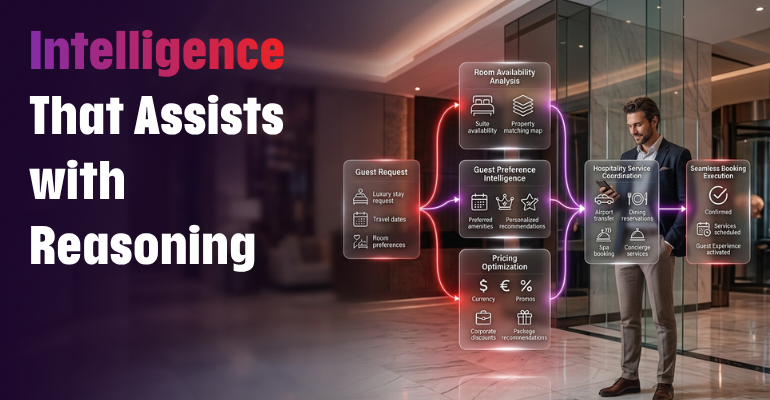
You need to reschedule a client meeting, pull last quarter's sales data, alert the finance team and draft a follow-up email. You ask your chatbot for help. It tells you how to check your calendar and retrieve the data manually. That is where the frustration begins and the real work starts.
This everyday gap between asking and doing is why enterprises are rethinking their AI strategy. A modern Virtual Digital Assistant is not a search bar with a voice. It is a smart, reasoning engine that plans, decides and completes tasks across your business tools.
What Is a Virtual Digital Assistant?
A Virtual Digital Assistant (VDA) is an AI-powered interface that combines natural conversation, emotional intelligence, and deep system integration. Unlike chatbots which follow scripted trees, a VDA understands context, adapts tone, and takes action across multiple enterprise systems.
The debate of VDA vs traditional chatbot comes down to capability. A chatbot answers questions. A VDA resolves problems. A chatbot follows rules. A VDA reasons through complexity. A chatbot is a tool. A VDA is a teammate.
Navigating the VDA vs Traditional Chatbot Shift
Traditional automation follows "if this then that" logic. Reasoning-centric AI models work differently. They understand goals, evaluate options and choose actions based on context rather than just rules.
Agentic AI workflows powered by reasoning-centric models can handle:
- Multi-step processes without human handoffs
- Ambiguous requests that require interpretation
- Exceptions that fall outside standard rules
- Cross-system coordination across departments
This is enterprise AI automation that adapts to reality. At TECHVED.AI we see this transition as a massive leap forward for business operations. By choosing solutions that can think logically companies move away from simple response mechanisms and move toward true cognitive automation.
Key Enterprise AI Agent Capabilities
Modern enterprise AI agent capabilities include:
Context memory: The agent remembers past interactions and current session details. No repetition. No lost context.
System integration: Agents connect to CRM, ERP, knowledge bases, and communication platforms. They act across systems not just within one.
Emotional intelligence: Agents detect frustration and adjust tone. They know when to escalate and when to persist.
Continuous learning: Every interaction improves future performance. The agent gets smarter over time.
Agentic AI for business automation means these capabilities work together. The agent understands. It decides. It acts. It learns.
VDA vs Traditional Chatbot: The Performance Gap
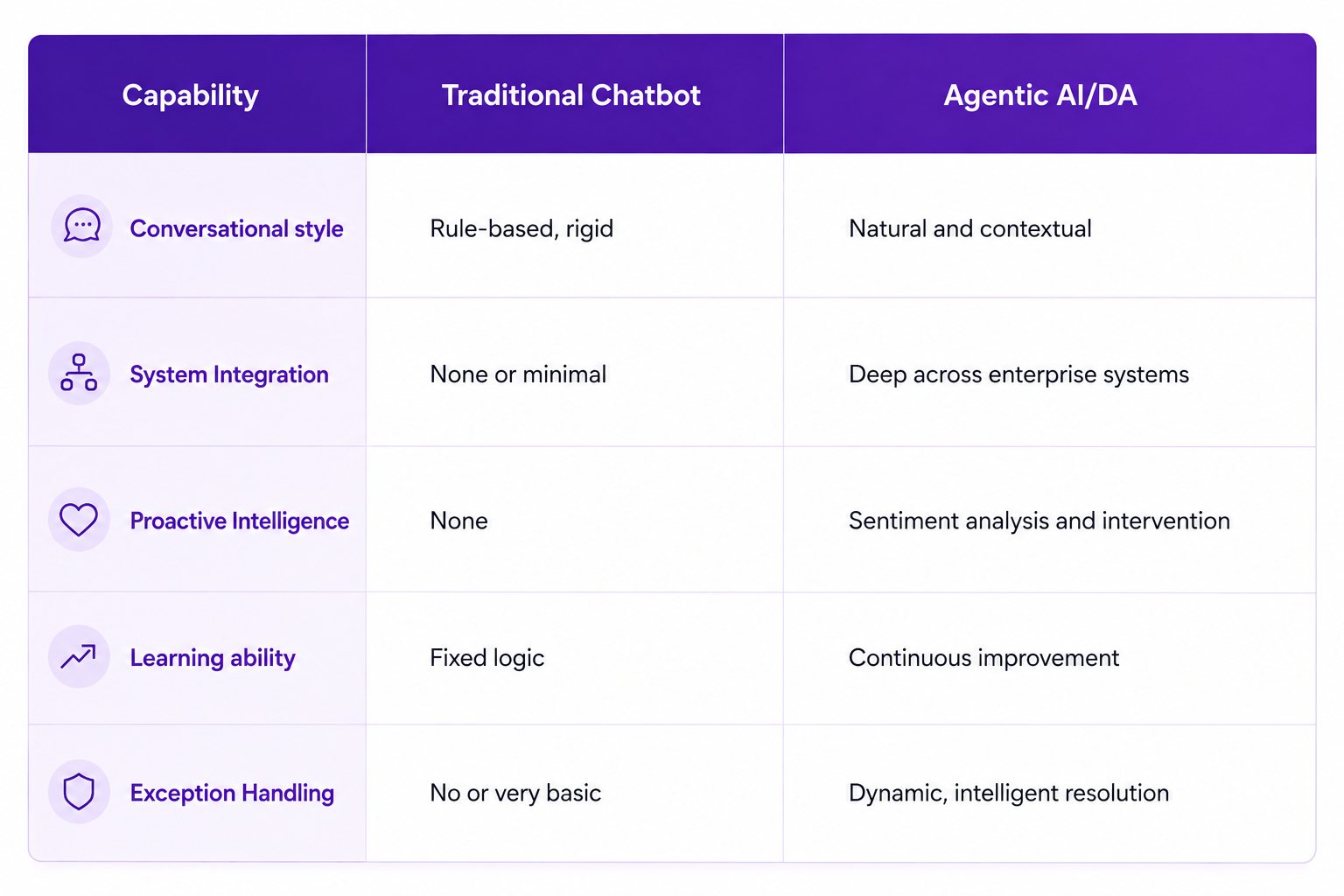
The gap is not incremental. It is transformative. Enterprises choosing Agentic VDA over chatbots see 40-60% higher resolution rates and 30-50% faster handling times.
Agentic VDA in Action: AI Orchestration in Enterprise Workflows
AI orchestration in enterprise workflows means multiple agents working together. A customer request might trigger:
- A Virtual Digital Assistant handling the conversation
- A sales agent qualifying the lead
- A compliance agent checking regulatory requirements
- A fulfillment agent processing the order
The orchestration layer ensures all agents share context and coordinate actions. This is enterprise AI automation at scale. A single customer inquiry triggers a coordinated effort among multiple AI agents. They handle standard, routine cases from start to finish without requiring any human intervention.
Why the Shift is Accelerating
Companies now measure AI success by tasks completed, not queries answered. A reasoning assistant that closes tickets, generates reports and coordinates teams delivers clear ROI. It reduces busywork, cuts response times and frees people for creative strategy.
TECHVED.AI builds these intelligent systems to help enterprises move from pilot projects to production-grade automation. Their platforms bridge the gap between AI promise and daily operational reality.
The Bottom Line
The enterprise AI race is not about having the biggest model. It is about having assistants that actually finish the job. A Virtual Digital Assistant powered by reasoning is the difference between talking about work and getting it done.
Ready to shift from conversation to action? Contact TECHVED.AI and put reasoning-centric AI to work in your enterprise.
FAQs
What defines a Virtual Digital Assistant?
It is an AI system that understands natural language, reasons through complex tasks and takes action across business tools.
How does a VDA differ from a traditional chatbot?
VDA vs traditional chatbot comparisons show that VDAs handle multi-step reasoning and cross-platform actions while chatbots stick to single-turn responses.
What are agentic AI workflows?
They are processes where an AI autonomously plans and executes tasks across multiple tools with minimal human intervention.
Can reasoning-centric AI models work with existing enterprise software?
Yes. Through AI orchestration in enterprise workflows, these assistants connect to CRMs, ERPs and other systems via APIs.
How do reasoning-centric AI models improve customer satisfaction?
By using reasoning-centric AI models the assistant can understand context and intent. This means users get accurate resolutions faster without dealing with robotic loops.
Most Popular
How AI-Driven Video Content Is Revolutionising Business Communication
Synthetic Media Ethics: Maintaining Authenticity in the Age of Avatars
Why AI Is No Longer Optional for the Insurance Industry in 2026
Green AI for Enterprises: Building Energy-Efficient Intelligence at Scale
From Clicks to Conversations: How Video Messaging Is Replacing Traditional Funnels
Introducing HOLA VDA: The Future of Humanized AI Conversations
Digital Literacy 2.0: Navigating the Shift from Text to Video-First Communication
Written By
Jay Anthony
Marketing Manager | TECHVED Consulting India Pvt. Ltd.
Jay Anthony holds expertise across a broad range of tech and innovation sectors. Driven by a passion for exploring ideas and sharing insight, Jay aims to craft work that is thoughtful, engaging and accessible. Whether diving into new subjects or reflecting on familiar ones, the goal is always to connect with readers and offer something meaningful.

Stay up-to-date with
all new market trends and
happenings
 #AIVideoContent #AIInBusiness #BusinessCommunication
How AI-Driven Video Content Is Revolutionising Business Communication
#SyntheticMedia #AIEthics #DigitalHumans #AIAvatars
Synthetic Media Ethics: Maintaining Authenticity in the Age of Avatars
#AgenticAI #InsuranceTech #AITrends2026 #InsuranceInnovation
Why AI Is No Longer Optional for the Insurance Industry in 2026
Ready To Transform?
Automate smarter. Create faster. Grow with AI.