 Back
BackThe Shift from Predictive AI to Reasoning AI Agents: What Is Driving Enterprise Adoption
#ReasoningCentricAI #AgenticAI #EnterpriseAIAgents #AIReasoningModels #TECHVEDAI

Jay Anthony
6 July 2026 | 4 min read

Imagine planning a trip. A basic GPS tells you what time you will arrive based on historical traffic patterns. That is helpful but if a sudden storm hits, blocks the highway and cancels your hotel, the GPS cannot call a nearby lodge or rebook your stay. You have to do the heavy lifting. In the corporate world, traditional systems face the same limit. While pattern matching has served businesses well, the paradigm is shifting toward reasoning-centric AI models that do more than look ahead. They decide and execute appropriate actions.
Predictive AI vs Reasoning AI: What Actually Changed
Predictive AI reads historical data and tells you what is likely to happen. A reasoning-centric AI model reads the situation, determines the right response and carries it out across whatever systems it needs to touch. The output shifts from a recommendation to an action.
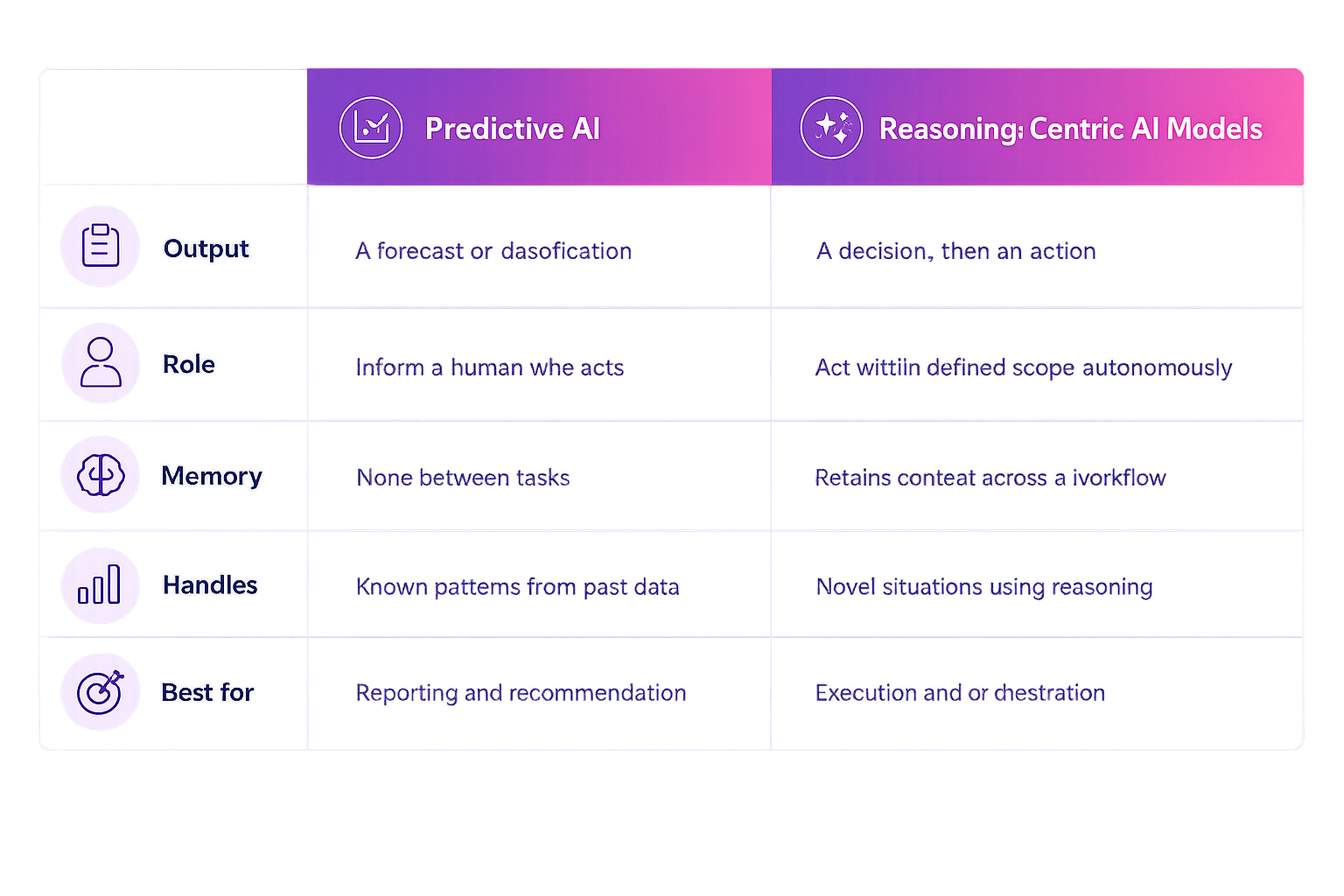
Predictive AI tells you a customer is likely to churn. A reasoning AI agent reads that signal, drafts a personalized retention message, checks the account history and sends it. Same data but completely different outcome.
What Is Driving Enterprises to Adopt Reasoning AI Now
The shift is not happening because reasoning-centric AI models just became available. It is happening because the cost of reactive operations has become visible and the technology to replace it is no longer experimental.
The specific drivers enterprises cite most often:
Workflow complexity: Multi-step processes that cross three or four systems cannot be handled by a model that only answers questions
Speed expectations: Customers and internal teams expect responses and actions in seconds, not after a human reviews an AI report
Labour costs: AI workflow automation through reasoning models replaces coordination overhead without replacing the judgment it genuinely needs
Governance maturity: Enterprises now have the architecture experience to deploy autonomous AI agents with the right scope boundaries and escalation logic in place
The Rise of Reasoning-Capable Agents
By 2026, reasoning has become default in every model. Agentic AI is moving from reactive chatbots to autonomous digital entities capable of independent reasoning, multi-step planning, and direct interaction with software ecosystems.
Reasoning-centric AI models enable a full reasoning-to-action loop. Models handle reasoning and interpretation. Execution engines handle governed action inside enterprise environments. The result is intelligent automation that thinks and acts.
From Automation to Orchestration: What Enterprises Actually Get
Traditional intelligent automation handles repeatable tasks with predictable inputs. Agentic AI handles variable situations with dynamic inputs. That sounds like a minor distinction but in practice it is the difference between automating a form and automating a decision.
A reasoning-centric AI model in a sales context does not just score a lead. It scores the lead, determines the right outreach timing, drafts a personalised message and updates the CRM, all within a single AI decision making loop. That is next generation AI operating at the level enterprises have been waiting for.
How TECHVED.AI Builds for the Reasoning Era
TECHVED.AI designs enterprise AI agents built on reasoning-centric AI models that go past prediction into execution. Every deployment maps the right reasoning scope to the right workflow, with governance and escalation architecture built in from day one. The result is enterprise automation that does not just surface insights but acts on them reliably across complex operational environments.
The Forecast Was Never Enough
Knowing what will happen and doing something about it are two different capabilities. Reasoning-centric AI models close that gap. They are why enterprise AI agents are moving from pilot to production, and why the organizations investing in them now are building a structural advantage over those that are still waiting for another report.
TECHVED.AI is built to design and deploy that reasoning layer, end to end.
FAQs
What are Reasoning-centric AI models?
Reasoning-centric AI models are systems that construct causal understanding, evaluate scenarios and generate adaptive responses rather than merely identifying historical patterns.
How does Predictive AI vs reasoning AI compare?
Predictive AI forecasts based on past data. Reasoning AI understands why outcomes occur, models alternatives and adapts when conditions change.
What are enterprise AI agents?
Enterprise AI agents are autonomous systems that execute complex business workflows through perception, reasoning and action without continuous human direction.
What is agentic AI?
Agentic AI refers to systems that pursue goals independently, making decisions and completing tasks through reasoning rather than following predefined scripts.
How does AI workflow automation improve operations?
It handles complexity, exceptions and uncertainty autonomously, reducing human cognitive load while increasing response speed and consistency.
Most Popular
How AI-Driven Video Content Is Revolutionising Business Communication

Synthetic Media Ethics: Maintaining Authenticity in the Age of Avatars
Why AI Is No Longer Optional for the Insurance Industry in 2026
Green AI for Enterprises: Building Energy-Efficient Intelligence at Scale
From Clicks to Conversations: How Video Messaging Is Replacing Traditional Funnels
Introducing HOLA VDA: The Future of Humanized AI Conversations
Digital Literacy 2.0: Navigating the Shift from Text to Video-First Communication
Written By
Jay Anthony
Marketing Manager | TECHVED Consulting India Pvt. Ltd.
Jay Anthony holds expertise across a broad range of tech and innovation sectors. Driven by a passion for exploring ideas and sharing insight, Jay aims to craft work that is thoughtful, engaging and accessible. Whether diving into new subjects or reflecting on familiar ones, the goal is always to connect with readers and offer something meaningful.

Stay up-to-date with
all new market trends and
happenings
 #AIVideoContent #AIInBusiness #BusinessCommunication
How AI-Driven Video Content Is Revolutionising Business Communication
#SyntheticMedia #AIEthics #DigitalHumans #AIAvatars
Synthetic Media Ethics: Maintaining Authenticity in the Age of Avatars
#AgenticAI #InsuranceTech #AITrends2026 #InsuranceInnovation
Why AI Is No Longer Optional for the Insurance Industry in 2026
Ready To Transform?
Automate smarter. Create faster. Grow with AI.